
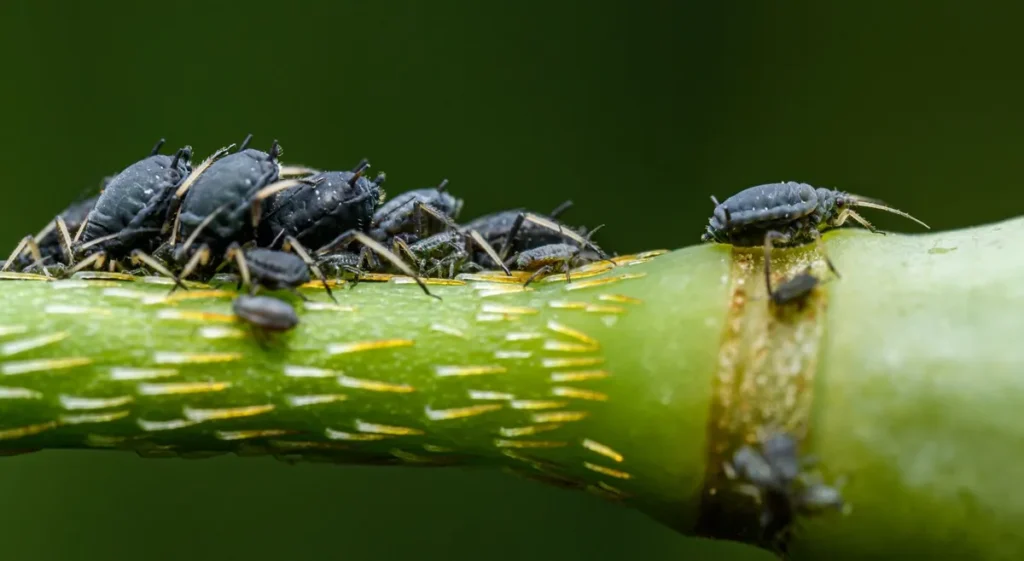
Last spring I bent down to smell a rose and the bud felt sticky under my fingers. I looked closer and the whole stem was crawling with tiny green insects, packed shoulder to shoulder like commuters on a crowded train. My first thought was some kind of mite. My second thought was panic. It turned out to be rose aphids, one of the most common garden pests in America, and that sticky feeling was honeydew, the sugary waste aphids drip onto everything below them.
That experience is exactly why this aphid identification chart exists. Aphids are tiny, usually 1 to 6 millimeters long, and there are more than 4,000 species worldwide. Around 250 of them are serious plant pests. Telling one species from another matters, because the aphid on your roses calls for a different response than the one on your corn, and neither behaves like the one living on your apple tree roots.
Below you will find 20 of the most common aphids in the United States, with real identifying data for each: color, size, host plants, the single feature that gives it away, and where it shows up. Use the table for a fast match, then work through the five-step method to confirm what you are looking at.

Aphid Identification Chart: 20 Common Species
Scan the color column first, then confirm with size and host plant. Aphid colors can shift with temperature and diet, so the key ID feature column is your tiebreaker when two species look alike.
| Common name | Scientific name | Color | Size | Host plants | Key ID feature | Region |
|---|---|---|---|---|---|---|
| Green peach aphid | Myzus persicae | Light green to yellow | 2 to 3 mm | Peaches, potatoes, peppers, tomatoes | Pear-shaped body with very long antennae | Worldwide |
| Black bean aphid | Aphis fabae | Black to dark brown | About 2 mm | Beans, sugar beet, spinach, nasturtium | Shiny black colonies packed tight on stems | Europe, North America |
| Cabbage aphid | Brevicoryne brassicae | Grey-green with white waxy coating | About 2.5 mm | Cabbage, broccoli, kale, Brussels sprouts | Powdery grey wax, feeds on leaf undersides | Worldwide |
| Woolly apple aphid | Eriosoma lanigerum | White, cottony wax-covered | About 2.5 mm | Apple, crabapple, elm | Fluffy white wax tufts on bark and roots | Europe, North America, Australia |
| Rose aphid | Macrosiphum rosae | Green, pink, or red | 2 to 3 mm | Roses and ornamental shrubs | Long legs and antennae, crowds rosebud tips | Worldwide |
| Potato aphid | Macrosiphum euphorbiae | Green or pink | 3 to 4 mm | Potato, tomato, lettuce, eggplant | Large aphid with long legs on leaf undersides | North America, Europe |
| Corn leaf aphid | Rhopalosiphum maidis | Blue-green | About 2 mm | Corn, barley, wheat, sorghum | Small oval body feeding deep in whorls and tassels | Worldwide |
| Cotton aphid | Aphis gossypii | Yellow-green to dark green or black | 1 to 2 mm | Cotton, citrus, cucumber, melon | Very small, color varies with the host plant | Tropical and temperate regions |
| Pea aphid | Acyrthosiphon pisum | Light green | 2.5 to 4 mm | Peas, alfalfa, clover, beans | Slender body with very long legs and antennae | Worldwide |
| Oleander aphid | Aphis nerii | Bright yellow-orange with black legs | 1.5 to 2.5 mm | Oleander, milkweed, butterfly weed | Neon yellow body with black appendages | Warm regions worldwide |
| Spirea aphid | Aphis spiraecola | Yellow-green | 1.5 to 2 mm | Citrus, spirea, apple | Causes tight leaf curl on citrus shoots | Worldwide |
| Soybean aphid | Aphis glycines | Pale yellow-green | 1.5 to 2 mm | Soybean | Black-tipped cornicles, colonies on leaf undersides | North America, Asia |
| Bird cherry-oat aphid | Rhopalosiphum padi | Olive green to brown with rusty-red rear | About 2 mm | Oats, wheat, barley, bird cherry | Reddish patch between the cornicles | Worldwide |
| Giant willow aphid | Tuberolachnus salignus | Dark brown to black with spotted back | 5 to 6 mm | Willow | The largest aphid most gardeners ever meet, forms trunk colonies | Europe, North America |
| Foxglove aphid | Aulacorthum solani | Shiny green or pink | 2 to 3 mm | Foxglove, greenhouse crops, potato | Dark patches at the leg joints | North America, Europe |
| Green apple aphid | Aphis pomi | Bright green | 1.5 to 2 mm | Apple, crabapple | Darker green stripes, curls new shoot leaves | North America, Europe, Asia |
| Rosy apple aphid | Dysaphis plantaginea | Rosy pink to purple-grey, waxy | 2 to 2.5 mm | Apple, plantain | Causes severe leaf curl and distorted fruit | Europe, North America |
| Honeysuckle aphid | Hyadaphis tataricae | Pale green to yellow | 1.5 to 2.5 mm | Honeysuckle | Causes witches-broom shoot clusters | North America, Europe |
| Chrysanthemum aphid | Macrosiphoniella sanborni | Dark mahogany brown, glossy | 2 to 3 mm | Chrysanthemum | Long golden-yellow cornicles | Worldwide |
| English grain aphid | Sitobion avenae | Green to brownish-yellow | About 2 mm | Wheat, barley, oats | Long black cornicles, feeds on grain heads | Worldwide |

How to Identify Aphids in 5 Steps
The table gives you a fast match. These five steps give you certainty, especially when the colony you found does not look exactly like any photo.
Step 1: Look for the cornicles
Aphids have a pair of small tubes sticking out of their rear end, called cornicles. They look like tiny tailpipes and no other common garden insect has them. If you see cornicles, you are looking at an aphid, full stop. A hand lens or a phone camera zoomed in makes them easy to spot. This single feature rules out whiteflies, psyllids, mealybugs, and thrips all at once.
Step 2: Check whether they cluster
Aphids are social feeders. They pack together on the softest, newest growth: shoot tips, buds, flower stems, and the undersides of young leaves. One lone insect wandering a leaf is probably something else. A crowd of dozens or hundreds, barely moving, all facing the same way with mouthparts sunk into the plant, is classic aphid behavior. Females give birth to live young all summer, so colonies explode fast.
Step 3: Follow the honeydew
Aphids drink far more sap than they can use, and they excrete the excess as honeydew, a clear sugary liquid. Sticky leaves, sticky car windshields parked under trees, and black sooty mold growing on leaf surfaces all point to aphids feeding above. Honeydew also attracts ants, which farm aphids the way people farm dairy cows, stroking them to harvest the droplets and defending them from predators. Ants marching up a stem in a steady line are a reliable aphid alarm. Our ant identification chart covers the species most often caught farming them, including the cornfield ant.

Step 4: Note the plant and the feeding spot
Most aphids are picky eaters, so the plant is often the best clue. Aphids on roses are usually rose aphids. A grey, waxy colony on cabbage is almost certainly cabbage aphid. Cottony white clusters on apple bark mean woolly apple aphid. Also note exactly where they feed: undersides of leaves (potato aphid, soybean aphid), shoot tips (green apple aphid), deep inside corn whorls (corn leaf aphid), or on roots underground (root aphids, covered below).
Step 5: Match color, size, and shape
Last, compare the body. Green peach aphids are pear-shaped with long antennae. Black bean aphids are shiny and dark. Pea aphids are long and slender. Woolly apple aphids look like moving cotton balls. Winged forms appear when a colony gets crowded and needs to migrate, so do not let wings throw you off. If you have cornicles, clustering, honeydew, and the right host plant, the color match in the table above usually seals it.
Identify Aphids by Color
Color is the fastest filter when you are standing in the garden with your phone. Start here, then confirm with the table.
- Green aphids: green peach aphid, pea aphid, potato aphid, rose aphid (green forms), foxglove aphid, green apple aphid, spirea aphid, soybean aphid, English grain aphid. The biggest group, so host plant matters most.
- Black or dark brown aphids: black bean aphid (shiny black on beans and beets), chrysanthemum aphid (glossy mahogany on mums), giant willow aphid (huge, on willow trunks).
- Yellow or orange aphids: oleander aphid (neon yellow with black legs on milkweed and oleander), cotton aphid (pale yellow forms on cucurbits).
- Red or pink aphids: rose aphid (pink forms on rosebuds), potato aphid (pink forms), rosy apple aphid (rosy pink on apple).
- Grey, white, or waxy aphids: cabbage aphid (powdery grey on brassicas), woolly apple aphid (cottony white on apple bark), rosy apple aphid (waxy purple-grey).

Root Aphids: The Ones You Never See
Some aphids never touch a leaf. Root aphids feed underground on plant roots, so the first sign is usually a plant that wilts, yellows, or stalls for no visible reason. People often blame watering or soil, then discover the real problem when they unpot the plant and find white or cream-colored clusters clinging to the roots. They are easy to confuse with mealybugs, but root aphids have cornicles and are usually smaller and faster.
| Root aphid | Scientific name | Color | Size | Attacks | Warning signs |
|---|---|---|---|---|---|
| Lettuce root aphid | Pemphigus bursarius | Pale green | About 1.5 mm | Lettuce, endive roots | Stunted heads, roots covered in waxy clusters |
| Rice root aphid | Rhopalosiphum rufiabdominale | Dark olive with reddish abdomen | 1.5 to 2 mm | Rice, grasses, greenhouse crops | Yellowing despite good water, colonies at the root crown |
| Sugarbeet root aphid | Pemphigus populivenae | Cream to pale yellow | About 2 mm | Sugarbeet, bean roots | Wilting in moist soil, white clusters on feeder roots |
| Grape phylloxera | Daktulosphaira vitifoliae | Yellow to brown | About 1 mm | Grapevine roots | Galls and knots on roots, vine decline over years |
To check for root aphids, slide the plant out of its pot and look for small white or yellowish insects clustered on the roots and the inside of the pot wall. In garden beds, dig gently around a struggling plant and inspect the top few inches of roots. Replacing infested potting soil, rotating crops, and drenching with insecticidal soap or neem oil are the usual fixes.

Aphid or Lookalike? How to Tell
Several tiny sap-sucking insects get mistaken for aphids. Run this comparison before you decide.
| Trait | Aphids | Whiteflies | Psyllids | Mealybugs |
|---|---|---|---|---|
| Body | Soft, pear-shaped | Tiny, moth-like | Hard, cicada-like | Soft, oval, segmented |
| Cornicles | Yes, the tailpipe pair | No | No | No |
| Wings | Usually none, some winged | White powdery wings, fly up in clouds when disturbed | Fold rooflike over the body | Females wingless |
| Movement | Slow, barely moves | Flutter when touched | Jump when disturbed | Slow crawl |
| Coating | Sometimes waxy | White powder | Sometimes waxy threads | Heavy white mealy wax |
| Honeydew | Yes, sticky | Yes | Yes, plus waxy pellets | Slow crawl |
The cornicle test is the decider. If it has the two rear tubes, it is an aphid. Whiteflies rise in a white puff when you brush the leaf. Psyllids hop like tiny grasshoppers. Mealybugs look like someone dusted the insect in flour and tend to sit still in leaf joints.
Damage patterns help too. Aphids cause curling, yellowing, sticky honeydew, and sooty mold. Chewed holes with missing leaf chunks point to caterpillars instead, and our caterpillar identification chart covers the 20 species you are most likely to find. Fine stippling or bronzing with webbing means spider mites, not aphids.

Natural Predators and Biological Control
Before reaching for a spray, look at who is already eating your aphids. A healthy garden usually has a cleanup crew on patrol, and identifying them is half the fun.
Ladybugs are the famous ones. One ladybug larva can eat hundreds of aphids before it pupates, and the larvae, which look like tiny black and orange alligators, eat even more than the adults. Green lacewing larvae are just as hungry and less well known. Hoverfly larvae, the legless maggots of those striped flies that hover over flowers, patrol leaves eating dozens of aphids a day. Parasitic wasps, tiny stingless wasps the size of a pinhead, lay eggs inside aphids; parasitized aphids swell into tan, papery mummies stuck to the leaf, a sure sign the wasps are working.
Birds, especially chickadees and warblers, pick off winged aphids in spring. Ground beetles and soldier beetles eat aphids that fall to the soil. If you want to learn the beetle side of this food web, our beetle identification chart covers ladybugs, soldier beetles, and 18 more species you will meet in the garden.
To encourage predators, skip broad-spectrum insecticides, plant flowers with tiny blooms like alyssum, dill, and yarrow that feed adult hoverflies and wasps, and tolerate a small aphid colony or two. Predators need prey to stick around. A strong jet of water knocks most aphids off without chemicals, and insecticidal soap or neem oil handles the rest when numbers get out of hand.

Aphid Identification FAQs
Are all aphids green?
No. Green is the most common color, but aphids also come in black, yellow, orange, red, pink, brown, grey, and white, depending on species, host plant, and season. The oleander aphid is bright yellow-orange, the black bean aphid is shiny black, and the woolly apple aphid hides under white wax. Color alone never identifies an aphid, which is why the cornicles, clustering, and host plant matter more.
How can I tell aphids from whiteflies?
Brush the leaf. Whiteflies flutter up in a white cloud and resettle; aphids stay put. Aphids have cornicles (the tailpipe tubes) and soft pear-shaped bodies, while whiteflies look like tiny white moths with powdery wings. Both produce honeydew, so stickiness alone does not separate them.

What are the tiny white things among the aphids?
Usually shed skins. Aphids molt several times as they grow, leaving empty white husks stuck to the leaf that look like dead aphids. If the white thing is round and papery, it may be an aphid mummy, meaning a parasitic wasp developed inside. If it is fluffy and the insects under it are slow and oval, you may be looking at mealybugs instead.
Do aphids bite people or pets?
No. Aphids feed only on plant sap. Their mouthparts are built for piercing stems and leaves, not skin, and they have no interest in people or pets. They do not sting, they are not venomous, and they do not spread disease to humans. The worst they do to a household is make houseplants sticky.
Can aphids kill a plant?
A large colony can seriously weaken or kill young plants, seedlings, and stressed houseplants by draining sap, and the viruses some species carry, like the green peach aphid’s potato viruses, can be worse than the feeding itself. Established healthy plants usually survive aphid feeding with cosmetic damage: curled leaves and sooty mold. Root aphids are the exception, since underground feeding can kill a plant before you ever see an insect.

Why do ants protect aphids?
Ants harvest honeydew, the sugary waste aphids excrete, and in return they guard the colony from ladybugs, lacewings, and parasitic wasps, sometimes even moving aphids to better feeding spots. This is why an ant trail up a stem usually means aphids above, and why controlling ants, with sticky trunk bands or bait, often lets predators finish the aphids for you.
Conclusion
Identifying aphids comes down to five observations: the cornicles, the clustering, the honeydew, the host plant, and the color. With those and the 20-species table above, the sticky mystery on your roses, cabbage, or corn stops being a mystery. You will know whether you are looking at a green peach aphid that vectors viruses, a woolly apple aphid hiding in bark crevices, or a harmless-looking colony that a few ladybugs will clear up on their own. Bookmark this aphid identification chart for the next time a stem starts crawling, and let the predators do the heavy lifting whenever you can.




Pingback: Bug Identification Chart: Identify 20 Common Bugs by Sight – Chart Identify