A weevil in a bag of rice looks like a tiny dark speck with a snout, and most people only notice it when it is already marching across the kitchen counter. What surprises most people is how much the weevil lifespan chart varies from one type to the next. A rice weevil finishes its whole life in about four to six months, while a pine weevil can live for six years.
Weevils are not one pest. They are a huge family of beetles, the largest family in the whole animal kingdom, with about 97,000 known species. Most of a weevil’s life is spent out of sight, as a soft, legless grub hidden inside a seed, a root, or a tree trunk. The long-snouted adult that you actually see is usually the last and shortest chapter of the story. This chart lists the typical and maximum lifespan of 20 weevil types, explains why some last for years and others for months, and shows which ones are the famous pests worth knowing by name.
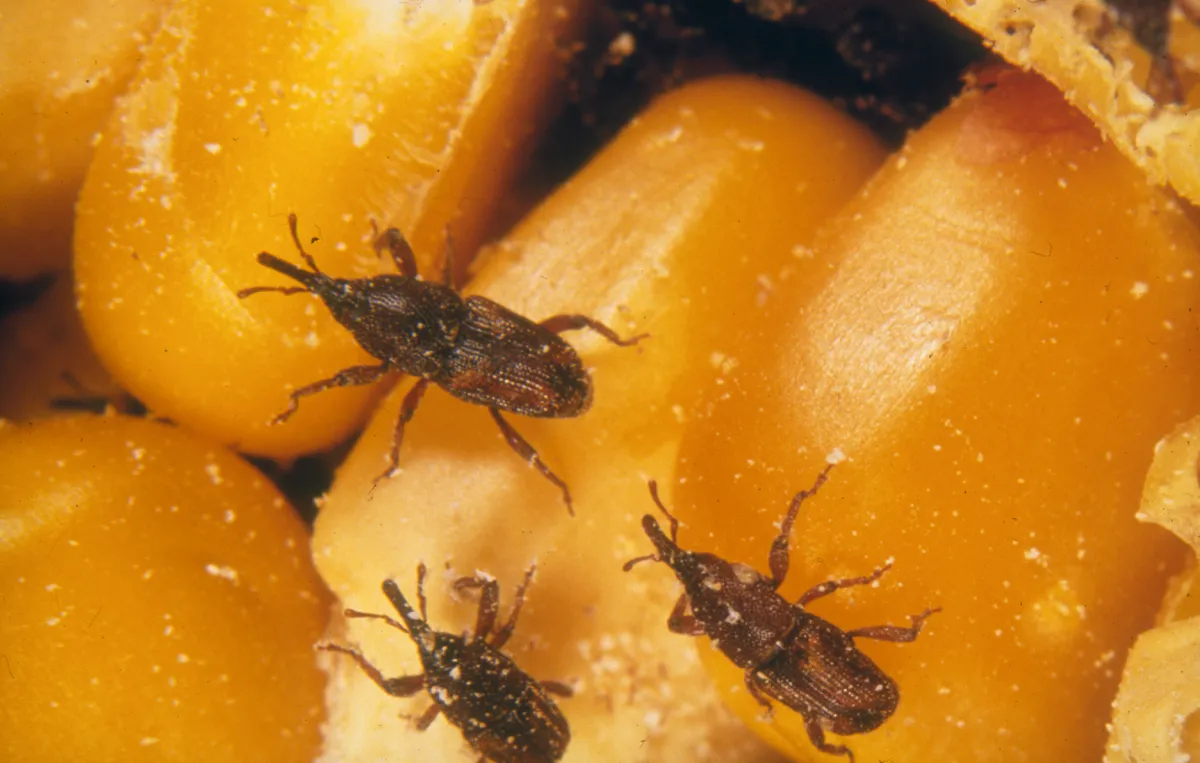
The rice weevil is the pantry pest most people meet first. Its whole life, from egg to adult death, usually takes four to six months.
Weevil Lifespan Chart: 20 Types Compared
The typical column below shows the usual range from egg to adult death, and the maximum column shows the longest recorded lifespan for that type. Most of the variation comes down to where the larva grows up. Grain weevils develop fast in warm, food-rich kernels. Root, nut, and wood weevils grow slowly inside hard, well-protected hiding places, and that slow start stretches into a much longer life.
| Weevil Type | Scientific Name | Typical Lifespan | Maximum Lifespan |
|---|---|---|---|
| Rice weevil | Sitophilus oryzae | 4-6 months | 8 months |
| Granary weevil | Sitophilus granarius | 6-8 months | 1 year |
| Maize weevil | Sitophilus zeamais | 4-8 months | 1 year |
| Boll weevil | Anthonomus grandis | 3-8 months | 1 year |
| Bean weevil | Acanthoscelides obtectus | 2-4 months | 6 months |
| Sweet potato weevil | Cylas formicarius | 2-7 months | 1 year |
| Red palm weevil | Rhynchophorus ferrugineus | 4-12 months | 1.5 years |
| Palmetto weevil | Rhynchophorus cruentatus | 4-8 months | 1 year |
| Pea weevil | Bruchus pisorum | 10-12 months | 1 year |
| Alfalfa weevil | Hypera postica | 10-12 months | 1 year |
| Vegetable weevil | Listroderes costirostris | 1 year | 2 years |
| Plum curculio | Conotrachelus nenuphar | 1 year | 2 years |
| Black vine weevil | Otiorhynchus sulcatus | 1-2 years | 3 years |
| Strawberry root weevil | Otiorhynchus ovatus | 1-2 years | 3 years |
| Citrus root weevil | Diaprepes abbreviatus | 1-2 years | 3 years |
| Banana weevil | Cosmopolites sordidus | 1-2 years | 4 years |
| Acorn weevil | Curculio glandium | 2-3 years | 4 years |
| Nut weevil | Curculio nucum | 2-3 years | 5 years |
| Pecan weevil | Curculio caryae | 2-3 years | 4 years |
| Pine weevil | Hylobius abietis | 2-4 years | 6 years |
Weevils are beetles, so this chart sits alongside our wider beetle lifespan chart, which shows how weevils compare with beetles that live for decades. If you want the full family picture, our types of weevils guide covers 20 species with sizes and habitats.
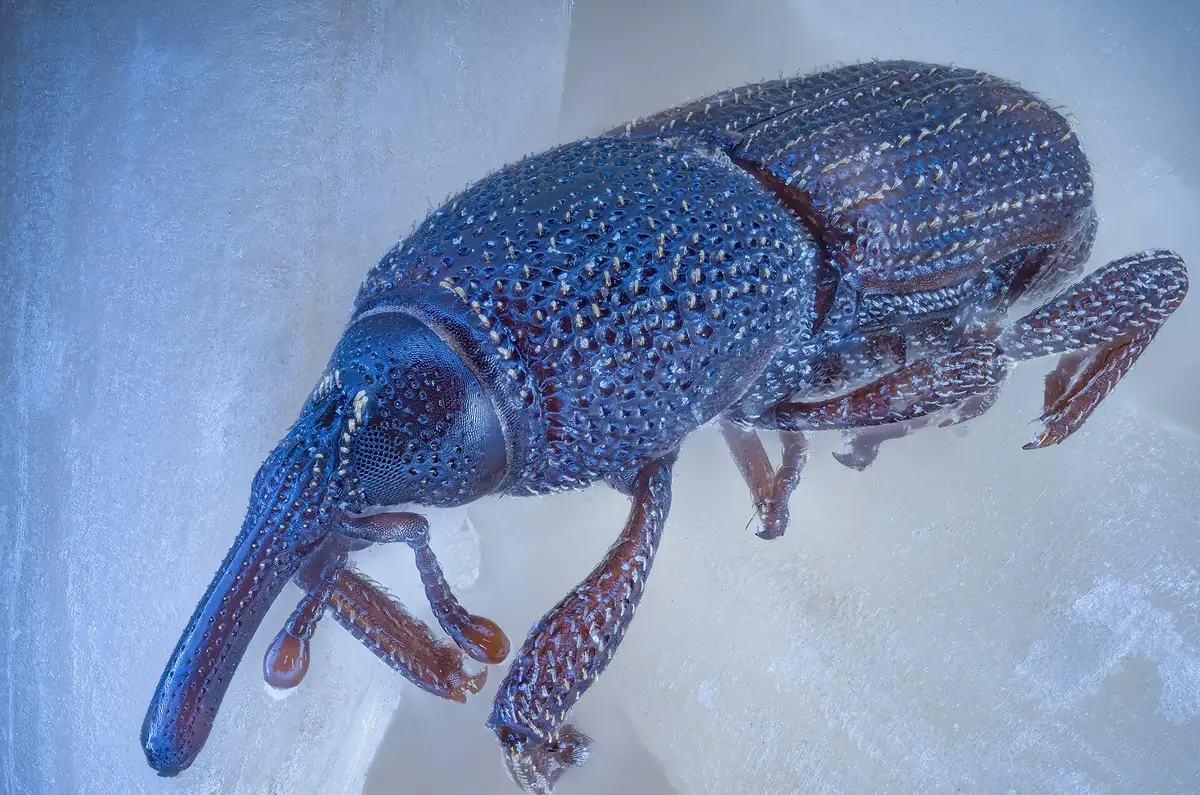
Stored grain weevils live the shortest lives on this chart, but they make up for it by breeding fast in warm pantries.
Which Weevils Live the Longest?
Pine weevils top the list. Adults can reach four years, with a maximum near six, because their larvae spend years feeding in conifer bark and roots before they pupate. Nut, acorn, and pecan weevils come next at two to three years. Their larvae develop slowly inside hard seeds and nuts, then drop to the soil and wait there, sometimes through more than one winter, before emerging as adults.
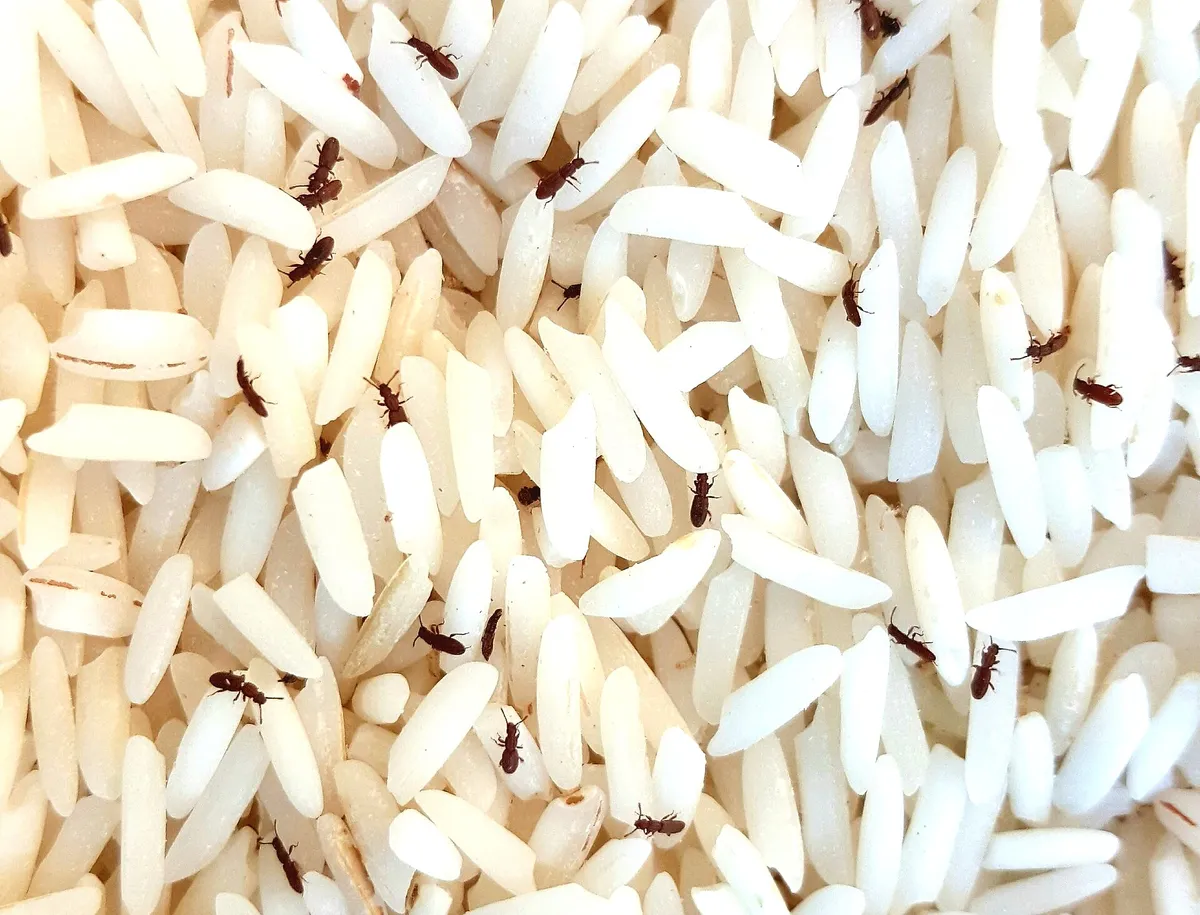
A grain kernel is a pantry and a nursery in one. The larva eats, grows, and pupates inside a single kernel, then chews its way out as an adult.
Which Weevils Live the Shortest?
The stored grain weevils live the shortest lives. Rice weevils manage four to six months, with maize and granary weevils close behind, and the bean weevil is shorter still at two to four months in warm storage. They make up for a short life by breeding fast. A female rice weevil can lay several hundred eggs, one inside each grain kernel, and in a heated pantry the cycle never stops for winter. That is why a small pantry infestation grows so quickly, and why one bag of infested rice can seed a whole cupboard.
The same trade shows up in the palm weevils. Red palm and palmetto weevils live four to twelve months, short for insects that can kill a tree, but they lay hundreds of eggs inside a single palm trunk. You can see how this compares with other short-lived insects in our bug lifespan chart.
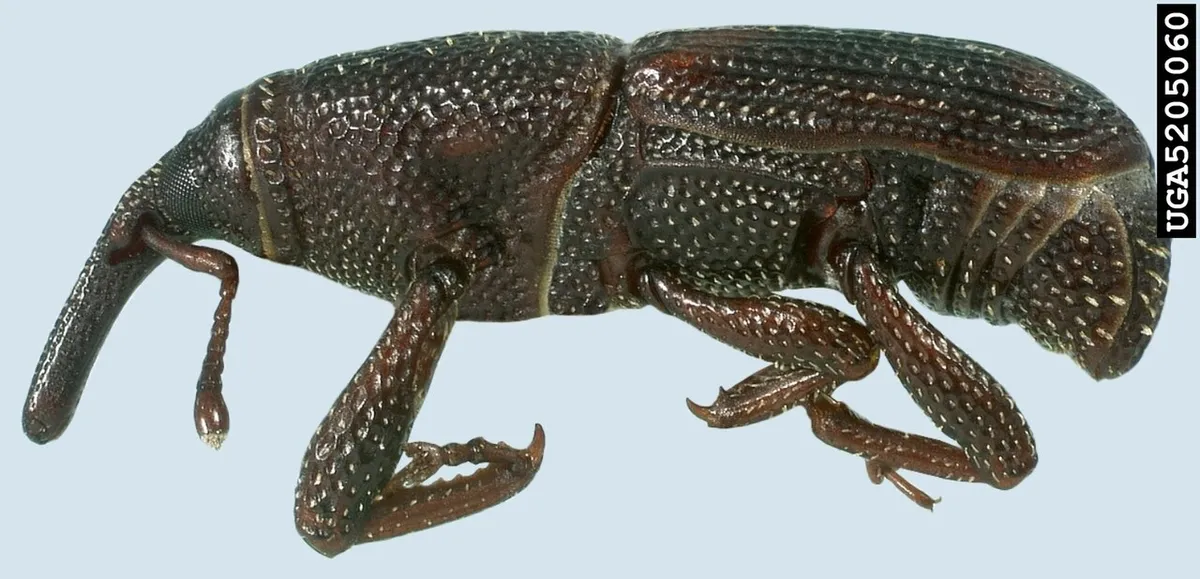
The long snout is the weevil’s signature tool. The female uses it to drill a hole in a grain kernel, then lays a single egg inside.
The Weevil Life Cycle: Egg, Larva, Pupa, Adult
Weevils are true weevils, or snout beetles, in the family Curculionidae. The long, downward snout is the feature that sets them apart. It carries the jaws at its tip and is used both to feed and to drill holes for eggs. Like all beetles, weevils go through complete metamorphosis: egg, larva, pupa, and adult. The larva is a soft, legless grub that feeds hidden inside a grain, a nut, a root, or a stem, and how long this stage lasts is what decides the total lifespan. A rice weevil larva finishes in about a month, while a pine weevil larva can spend several years inside a conifer root.
When the grub is ready, it pupates in place and emerges as the hard-shelled adult. The adult does the mating and egg-laying, and in many species it is the shortest stage of all. Some adults live only a few weeks. Others, like the pine weevil, can live for years as adults, feeding on bark and laying eggs across several seasons. For the egg side of the story, see our insect egg identification chart.
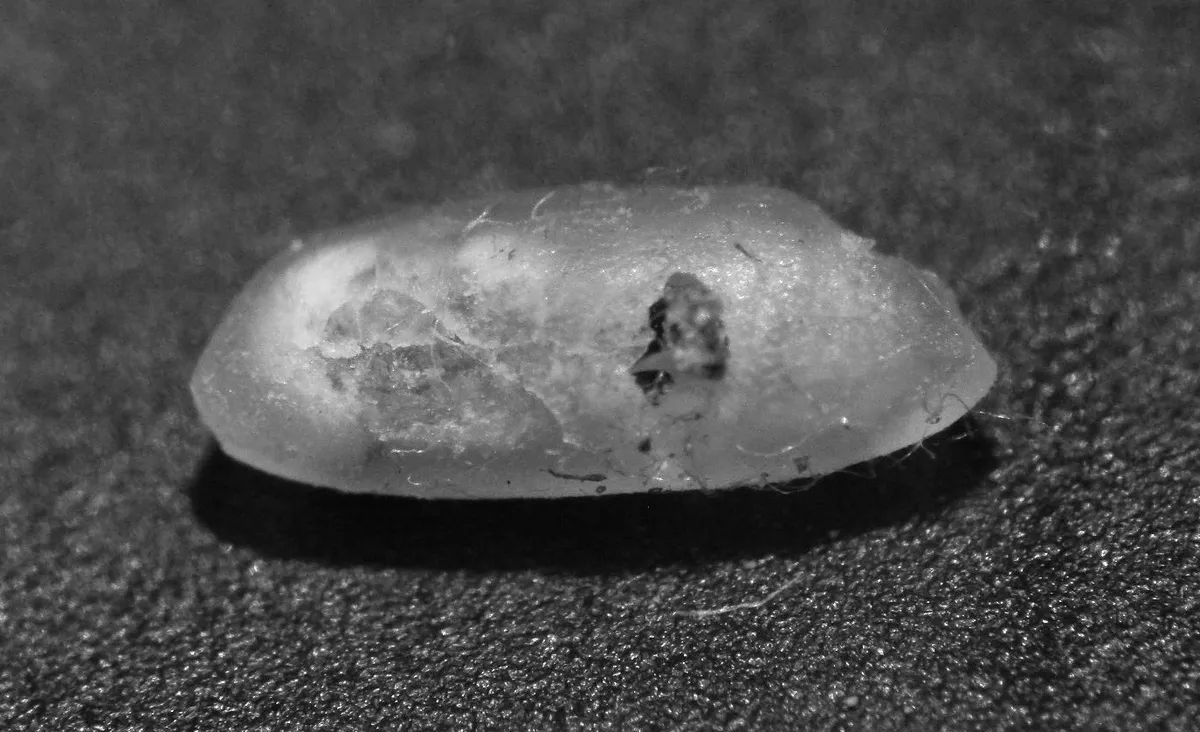
Rice weevils fly, unlike granary weevils, so they can spread from one stored product to another on their own.
Weevil Lifespan by Group
The 20 weevils above fall into a few natural groups, and lifespan tracks closely with where the larva feeds. Here is the quick version, sorted from the short-lived pantry pests to the long-lived borers.
| Weevil Group | Examples | Typical Lifespan | Where Larvae Develop |
|---|---|---|---|
| Stored grain weevils | Rice, granary, maize, bean | 2-8 months | Inside grain kernels and dried beans |
| Root and vine weevils | Black vine, strawberry root, citrus root | 1-3 years | Soil and plant roots |
| Seed and nut weevils | Acorn, nut, pecan | 2-3 years | Inside acorns and nuts, then soil |
| Forestry weevils | Pine | 2-4 years | Conifer bark and roots |
| Palm and crop weevils | Red palm, palmetto, banana, sweet potato | 4-12 months | Inside palms, stems, and tubers |
| Field and orchard weevils | Pea, alfalfa, vegetable, plum curculio | 1 year | Peas, alfalfa, vegetables, fruit |
Notice the field and orchard group in the last row. These weevils run on a strict one-year clock because their food only exists for one season. A pea weevil has to finish inside its pea before the harvest, and an alfalfa weevil has to finish before the field is cut. They pack the whole life cycle into a single year and overwinter as adults instead.
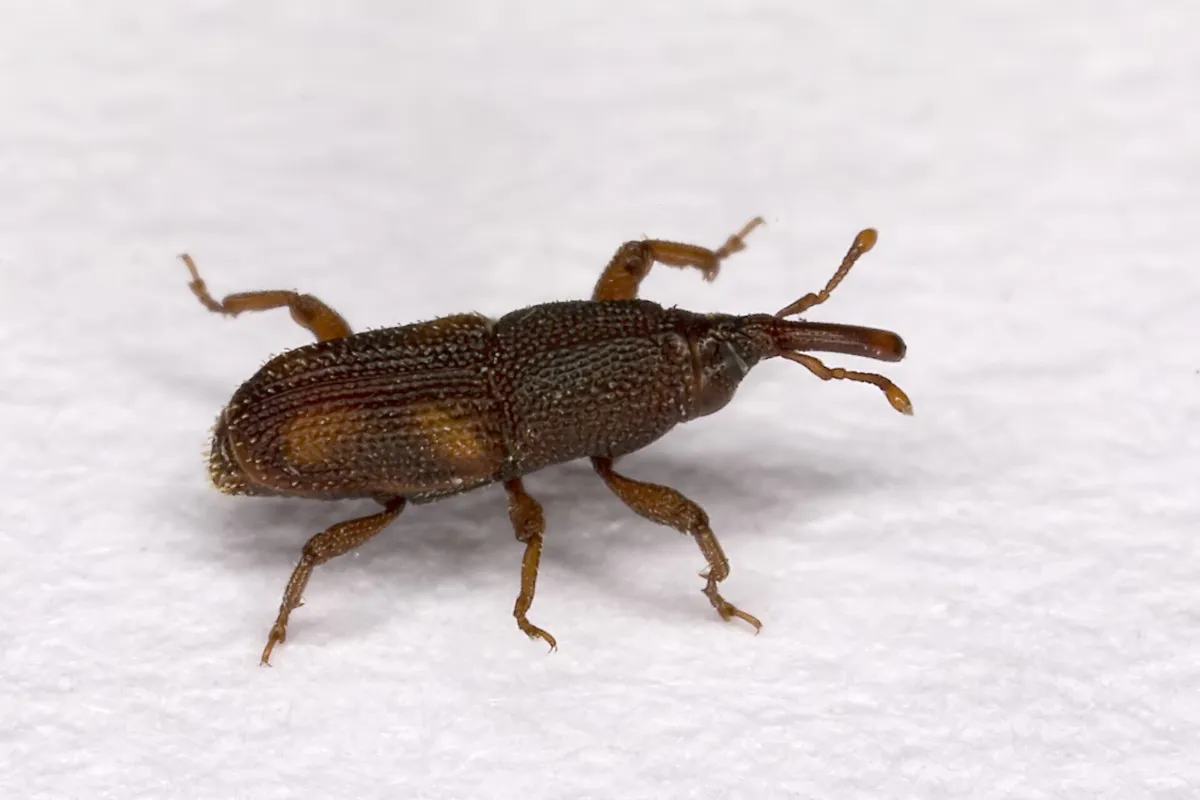
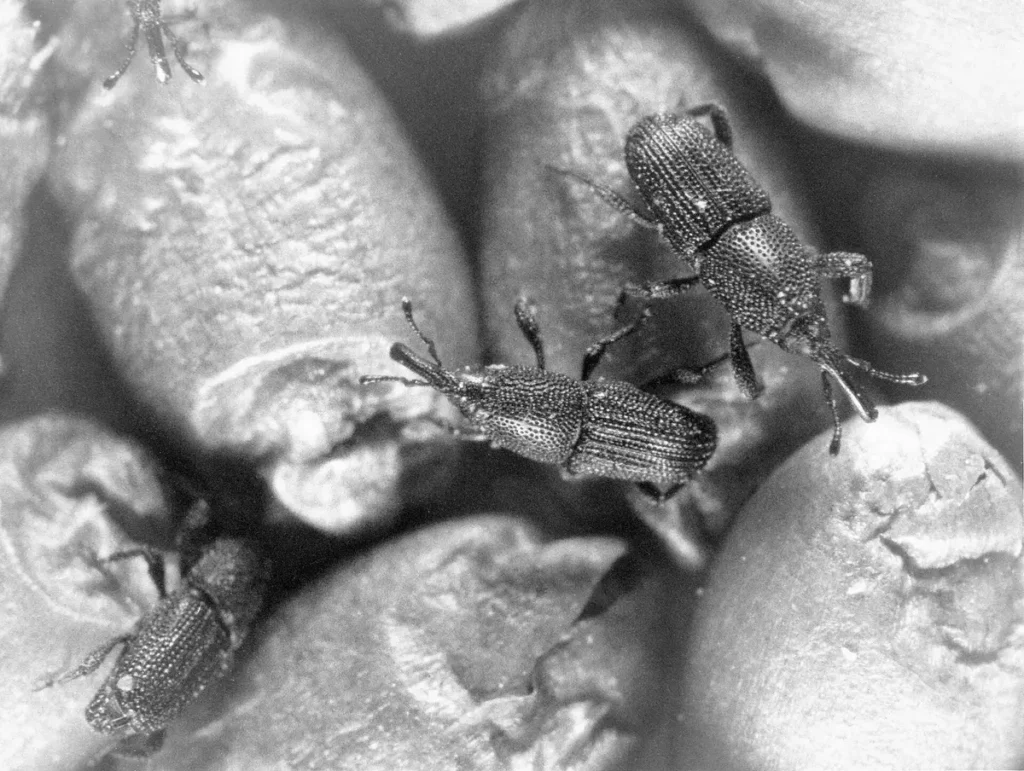
The ridged wing covers and the elbowed antennae on the snout are two quick ways to confirm a small brown beetle is a weevil.
What Makes Some Weevils Live Longer?
Two weevils of the same type can live very different lengths of time. A few factors explain most of the gap.
Species and food. Wood and root feeders develop slowly and live for years, while grain feeders finish in months. A larva eating a hard acorn or a pine root gets steady, well-protected food and grows slowly. A larva in a grain kernel gets rich food and grows fast, but the kernel is small and the pantry is a risky place.
Temperature. Warmth speeds development, so stored grain weevils breed year-round in a heated pantry but slow down in the cold. The same species can take twice as long to develop in a cool barn as in a warm kitchen.
Overwintering. Many weevils pause in a resting state called diapause, which can stretch the life cycle across a full year or more. Acorn and pecan weevils spend one or two winters buried in the soil as larvae. Plum curculio adults overwinter in leaf litter and emerge in spring to lay eggs in young fruit.
Habitat safety. Larvae sealed inside a seed or a trunk are well protected, which is part of why those species live longer. A grub inside a nut has almost no predators.
Predators and control. Birds, parasitic wasps, and pesticides cut many adult weevils short of their maximum. The maximum figures in the chart are for weevils that escape all of that. In a real garden or pantry, most weevils die well before their maximum.
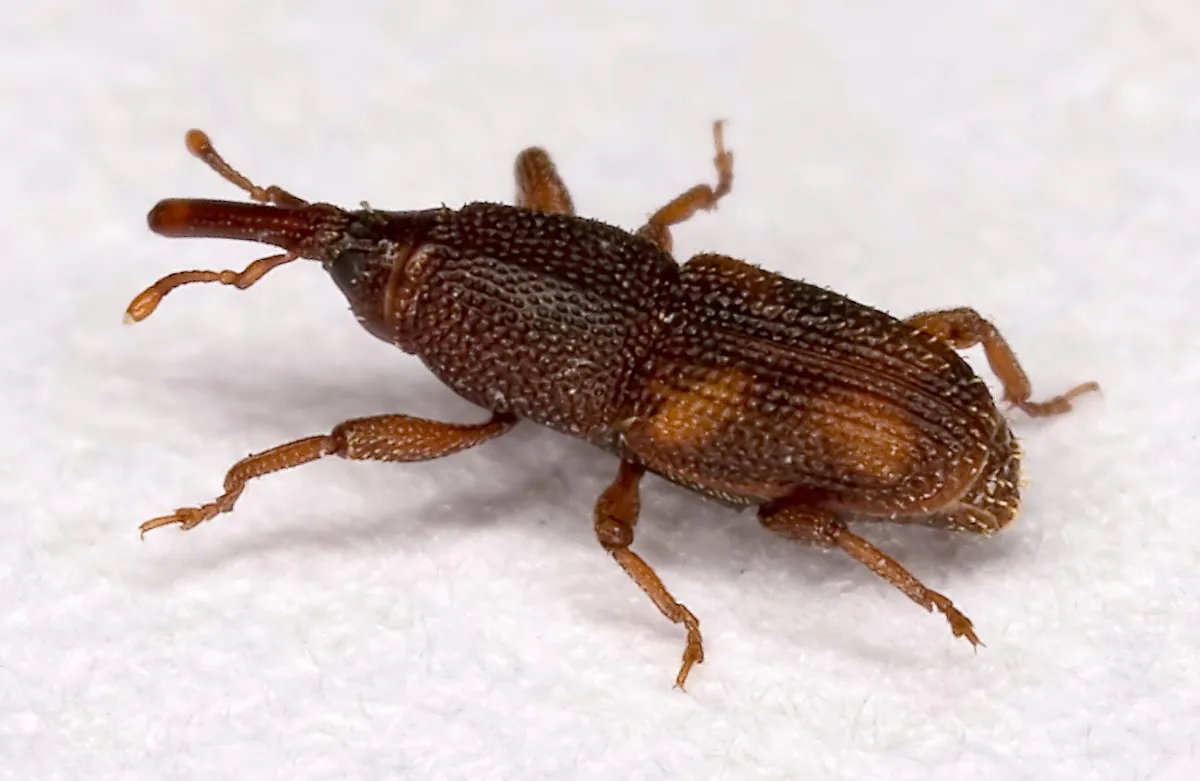
Warmth is the pantry weevil’s best friend. In a heated kitchen the cycle never pauses, so one generation follows the next all year.
Famous Weevils: Boll Weevil, Red Palm Weevil and More
The most famous weevil is the boll weevil. It crossed into the United States from Mexico in the 1890s and became the most destructive cotton pest in the country, costing the industry more than 23 billion dollars over the decades. A long government program eventually turned the tide, and the boll weevil is now cleared from more than 99 percent of US cotton land. For an insect that lives less than a year, that is a remarkable record of damage.
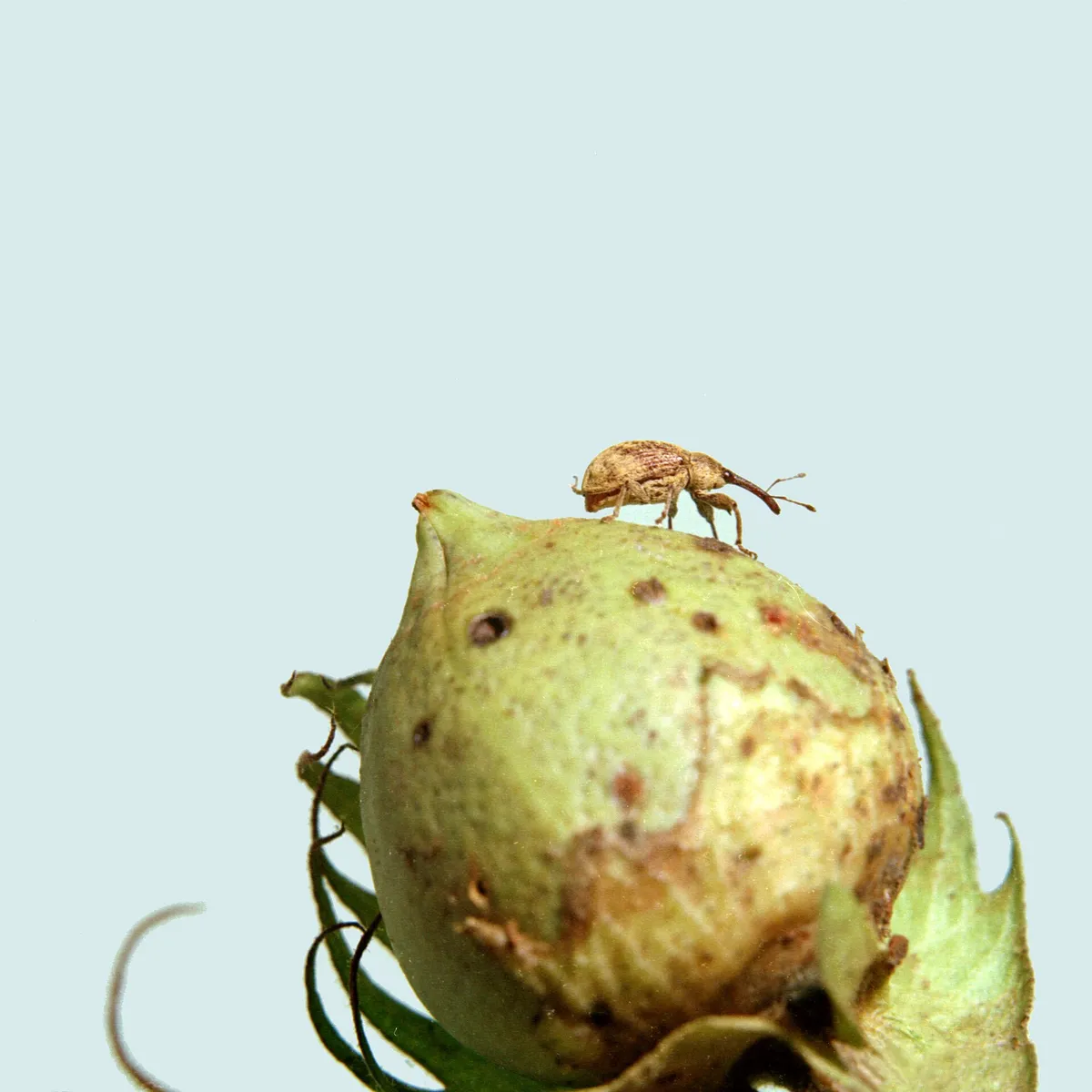
The boll weevil is small, grey-brown, and easy to miss, but it once reshaped the whole economy of the American South.
The red palm weevil is one of the worst palm pests in the world today, killing date and coconut palms across Asia, Europe, and beyond. The larvae eat the inside of the palm trunk, so by the time the damage shows on the outside, the tree is often beyond saving.
Two of the most unusual weevils on this chart are the black vine weevil and the strawberry root weevil. They are almost all female and can reproduce without mating, a trick called parthenogenesis that lets a single weevil start an infestation. The vegetable weevil shares the same trick, which is one reason it spread so fast after arriving in the United States from Australia.
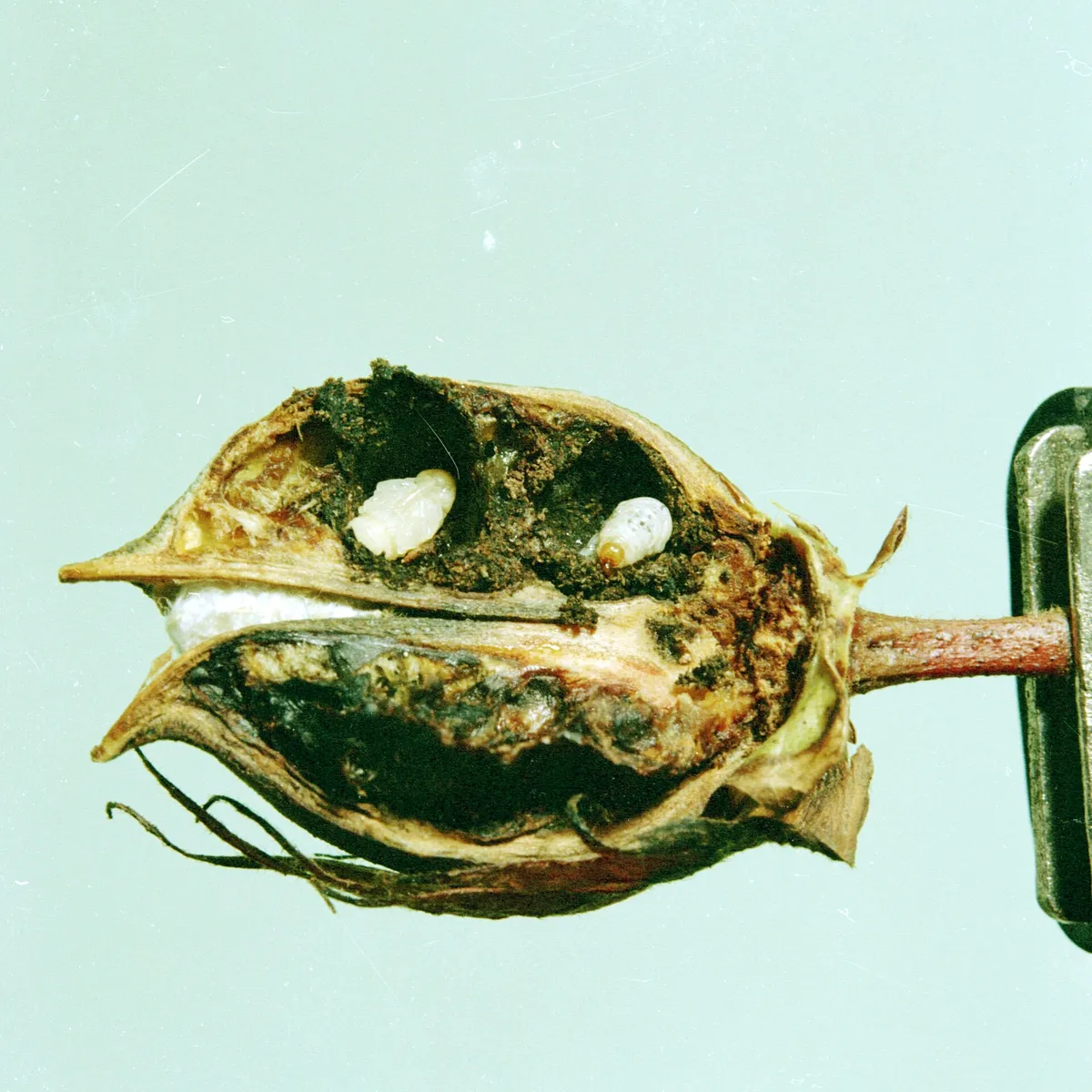
Boll weevils feed on cotton squares and bolls. A single female can lay about 200 eggs in a season, each one in its own cotton bud.
How to Tell a Weevil From Other Beetles
Three features give a weevil away. First, the snout. No other common beetle has a long, downward-pointing snout with the jaws at the tip and the antennae attached halfway along it. Second, the elbowed antennae. Weevil antennae bend sharply, like an elbow, and end in a small club. Third, the body shape. Most weevils are oval or pear-shaped with hard, often ridged wing covers, and many cannot fly at all.
In the pantry, the confusion is usually with sawtoothed grain beetles or flour beetles. Those have no snout, and their bodies are flatter and longer. If the insect in your flour has a snout, it is a weevil, and the rice, granary, and maize weevils in the chart above are the three to check first. The rice weevil flies and has four pale spots on its wing covers. The granary weevil cannot fly and has no spots. The maize weevil flies and is the largest of the three.
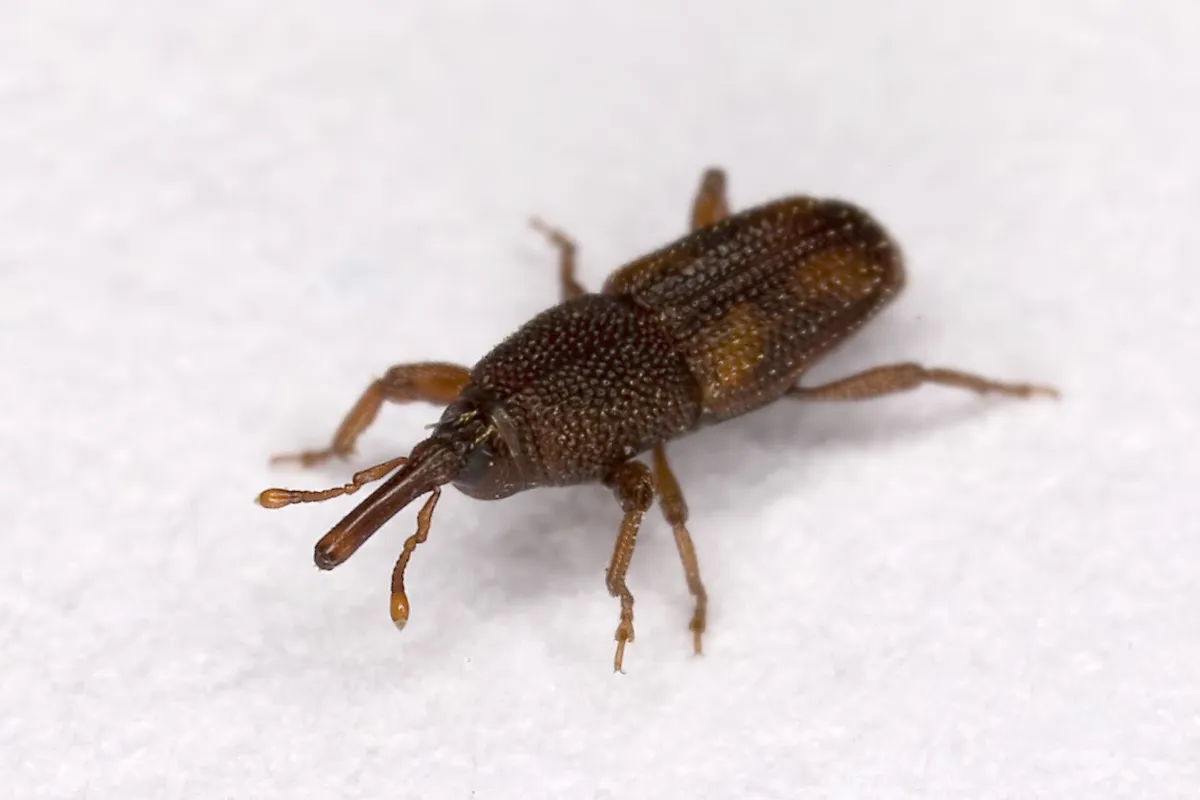
The elbowed antennae, attached halfway along the snout, are the fastest field mark for a true weevil.
FAQs
How long do weevils live?
It depends on the type. Grain weevils live about two to twelve months, while root, nut, and wood weevils can live two to six years, counting their long larval stage.
Are weevils beetles?
Yes. Weevils are beetles in the superfamily Curculionoidea, best known by their long snouts. The true weevils make up the family Curculionidae, the largest family in the animal kingdom, with about 97,000 known species.
Which weevil lives the longest?
The pine weevil lives longest, with adults reaching up to six years. Nut, acorn, and pecan weevils are next, often two to three years.
Which weevil has the shortest lifespan?
The bean weevil is among the shortest-lived, at two to four months in warm storage. Rice and maize weevils follow at four to six months. Most stored grain weevils live under a year but breed very quickly.
Do weevils go through a larva stage?
Yes. Weevils have complete metamorphosis with four stages: egg, larva, pupa, and adult. The larva is a legless grub that feeds hidden inside a seed, a root, or a stem.
Can weevils reproduce without mating?
Some can. Black vine, strawberry root, and vegetable weevils are almost all female and reproduce by parthenogenesis, so a single weevil can start a new infestation without a mate.
How long do weevils live in a pantry?
A pantry weevil usually lives four to eight months from egg to adult death. In a heated kitchen the cycle never stops, so new adults keep emerging all year.
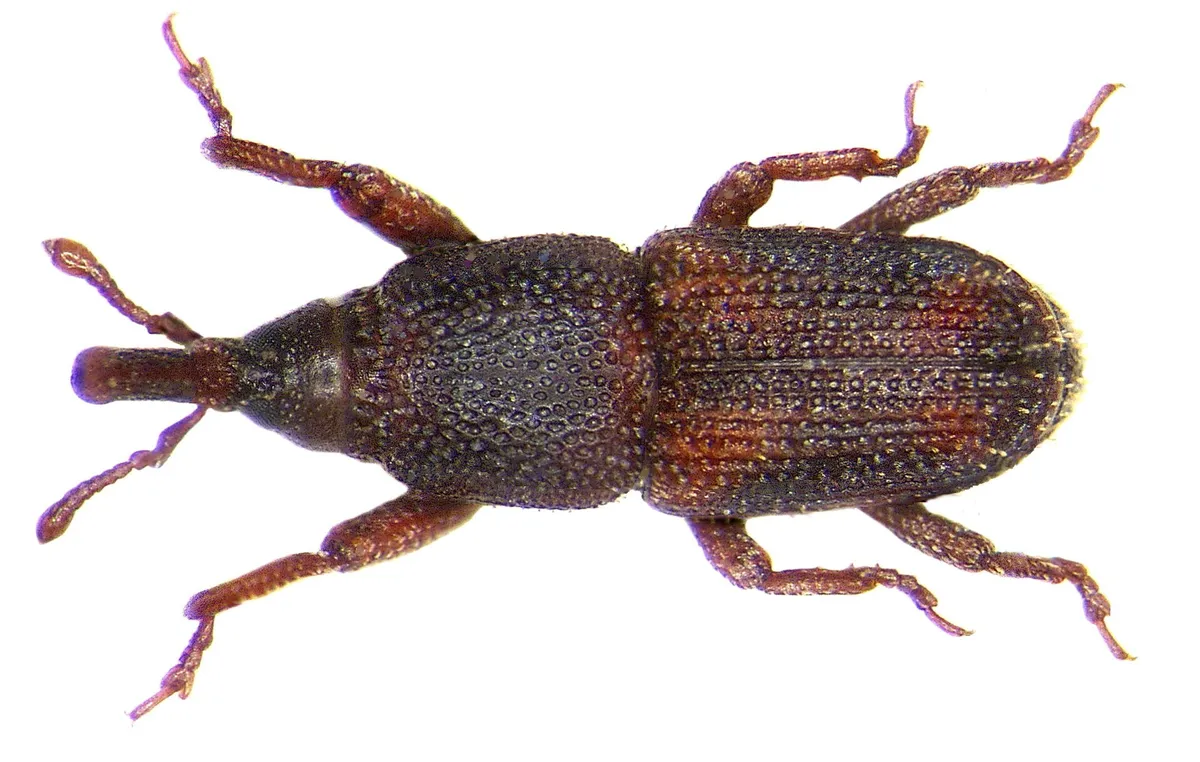
Weevil larvae are legless grubs that feed hidden inside a seed or root. The adult you see is the last and usually the shortest stage.
Conclusion
The weevil lifespan chart shows a family that runs from a few months to six years, and the difference is not random. Grain weevils live fast and breed fast in warm, food-rich kernels. Root, nut, and wood weevils live slow and long inside hard, hidden places where almost nothing can reach them.
If you found a weevil, start with the snout, then check where it was feeding. That combination will tell you which row of the chart you are looking at, how long it is likely to live, and how fast you need to act. For pantry pests, act fast, because a short life with hundreds of eggs adds up quickly.
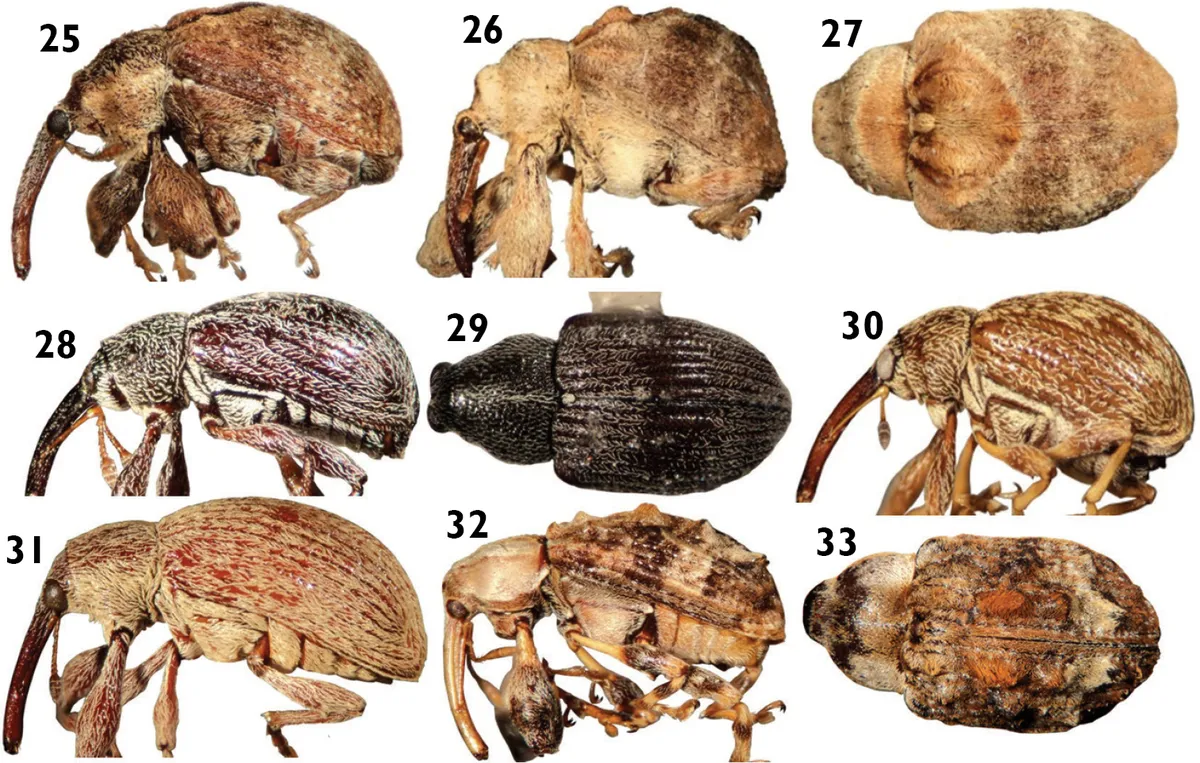
The boll weevil belongs to the Anthonomini tribe. Its relatives share the same snouted shape and the same habit of laying eggs inside flower buds.