
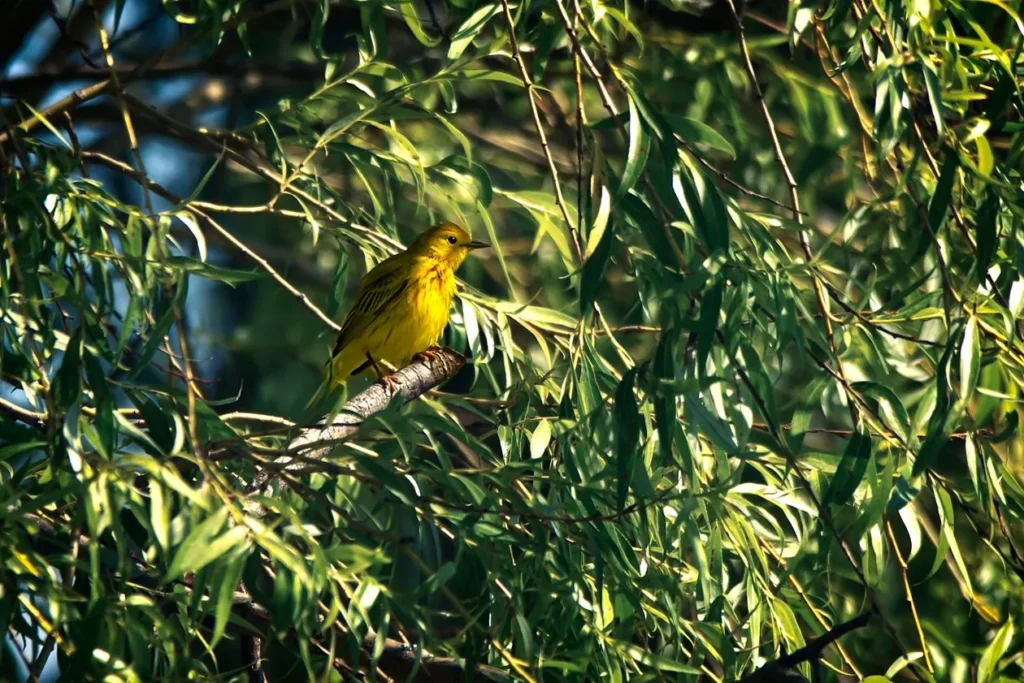
Warblers are the birds that humble birders. They are small, fast, and they spend most of their time high in the treetops, and the males you memorized from the field guide look completely different by September. This warbler identification chart is built to fix that. It covers 20 of the most common warbler species in the United States, with sizes, breeding ranges, habitats, field marks, and song hints for each one, so you can put a name on the bird in your binoculars instead of just calling it “a little yellow bird.”

North America hosts around 50 breeding warbler species, and a good spring morning can put 15 of them in one patch of woods. Nobody memorizes that overnight. The trick is learning the few field marks that actually separate species, then working through each bird one mark at a time.
Why Warblers Are the Hardest Birds to Identify
Three things conspire against you with warblers. First, size. Most warblers measure four to five and a half inches, which means the difference between a Tennessee warbler and a blackpoll warbler is a fraction of an inch you will never judge accurately in the field. Second, speed. Warblers glean insects off leaves almost constantly, flicking from branch to branch, and your view often lasts two seconds. Third, plumage changes. A male blackburnian warbler in May is a flame-throated jewel. That same bird in October is a washed-out olive bird that looks like five other species.
The way past all three problems is structure, not color alone. Experienced birders check the throat first, then the head pattern, wing bars, and tail, and only then the overall color. Add behavior and habitat, and most birds give themselves away. The chart below is organized around exactly those marks.
Warbler Identification Chart: 20 Common US Warbler Species
Use this chart as your quick reference. Species are listed with breeding range and habitat, the two or three field marks that matter most, and a song hint for the birds you hear more often than you see.
| Species | Size | Breeding Range and Habitat | Key Field Marks | Song Hint |
|---|---|---|---|---|
| Yellow Warbler | 5 in | Nationwide; willow thickets, shrubby wetlands, gardens | Entirely yellow; male has reddish-brown streaks on breast; yellow tail spots | Sweet-sweet-sweet, I’m so sweet |
| American Redstart | 5 in | East and North; second-growth woodland, thickets | Male black with bright orange wing and tail patches; fans tail while feeding | High, thin zeee-zeee-zeee |
| Common Yellowthroat | 4.3 to 5.1 in | Nationwide; marshes, wet thickets, weedy fields | Male has broad black mask and bright yellow throat; olive back; skulks low | Wichity-wichity-wichity |
| Northern Parula | 4.3 in | East; mature forest, often near water with hanging moss | Blue-gray above, yellow throat and breast; white eye crescents; chestnut breast band on male | Buzzy ascending trill ending in a sharp note |
| Black-throated Blue Warbler | 5 in | Northeast, Appalachians; mature deciduous forest understory | Male deep blue above, white below, black throat and face; white wing spot; female plain brown with white wing spot | Buzzy zoo-zoo-zoo-zeeee |
| Magnolia Warbler | 4.3 to 5.1 in | North, Appalachians; young conifers, mixed woods | Yellow below with black streaked necklace; bold white patches under tail that flash as it feeds | Weety-weety-weety |
| Blackburnian Warbler | 4.3 to 4.7 in | Northeast, Appalachians; mature coniferous canopy | Male has flame-orange throat and face with black crown; feeds at the very tops of trees | Extremely high, thin tsee-tsee-tsee |
| Palm Warbler | 4.7 to 5.5 in | Boreal bogs; winters across the Southeast US | Rusty cap; yellow undertail coverts; constantly pumps its tail up and down | Buzzy, weak trill |
| Blackpoll Warbler | 5.5 in | Boreal spruce-fir forest, Alaska to Newfoundland | Black cap, white cheeks, heavily streaked back; orange-pink legs; makes a nonstop transatlantic migration | Very high, thin seet-seet-seet |
| Chestnut-sided Warbler | 4.3 to 5.1 in | Northeast, Appalachians; shrubby second growth, forest edges | Yellow crown; chestnut streaks down the sides; feeds low where you can actually see it | Pleased-pleased-pleased-to-MEETCHA |
| Bay-breasted Warbler | 5.5 in | Boreal Canada; mature spruce-fir forest | Chestnut crown, throat and sides in spring; fall birds are greenish with faint streaking | High, thin seet-seet-seet |
| Tennessee Warbler | 4.7 in | Boreal forest; migrates through the eastern US | Plain olive-green above, pale eyebrow, whitish below; thin sharp bill; often hovers at leaf tips | Sharp ticka-ticka-ticka, speeding up |
| Black-throated Green Warbler | 4.7 to 5.1 in | Northeast, Appalachians; coniferous and mixed forest | Bright yellow face, olive back, black throat and upper breast; white belly | Zoo-zee-zoo-zoo-zee (trees-trees-murmuring-trees) |
| Northern Waterthrush | 5.1 to 5.9 in | North; wooded swamps, bogs, slow streams | Heavily streaked brown above and below; bold pale eyebrow; walks on the ground bobbing its tail | Loud, ringing sweet-sweet-sweet-chew-chew |
| Cape May Warbler | 4.7 to 5.1 in | Boreal spruce forest; migrates through the East | Tiger-striped breast; chestnut cheek patch on male; fine bill; often feeds high in spruces | Thin, high seet-seet-seet-seet |
| Black-and-white Warbler | 4.3 to 5.1 in | East; mature deciduous and mixed forest | Striped black and white all over; creeps along trunks and branches like a nuthatch | Squeaky, thin weesa-weesa-weesa |
| Yellow-rumped Warbler | 5 to 5.5 in | North and mountains; winters across most of the US | Yellow rump patch, yellow side patches, white throat (Myrtle form); the warbler you see most in winter | Loose, variable trill |
| Prothonotary Warbler | 5.1 in | Southeast; flooded bottomland forest, swamps | Brilliant golden-yellow head and breast; blue-gray wings; nests in tree cavities over water | Ringing sweet-sweet-sweet-sweet |
| Pine Warbler | 5.1 to 5.5 in | East; pine forests, also pine plantings and suburbs | Dull yellow with blurry streaks; two white wing bars; thick bill; rarely leaves pine trees | Musical, even trill |
| Wilson’s Warbler | 3.9 to 4.7 in | North and West; willow thickets, wet brush | Tiny and bright yellow; male wears a neat black cap; constantly flicks wings and tail | Chattering, descending series of chips |
How to Read a Warbler Like a Field Guide
When a warbler pops into view, work through the bird in the same order every time. Start with the throat: black narrows you to black-throated blue, black-throated green, or blackburnian; yellow points to yellow warbler, yellowthroat, or prothonotary; white suggests black-and-white or yellow-rumped.

Next, check the head: mask (common yellowthroat), cap (Wilson’s, blackpoll), eyebrow stripe (waterthrush, Tennessee), or eye crescents (northern parula). Then the wings for wing bars and the tail for white spots or a yellow rump. If you only get one look, make it the head pattern, because it survives the fall plumage change better than body color.
Behavior is your backup ID. A warbler creeping headfirst down a trunk is a black-and-white warbler, full stop. One pumping its tail like a metronome is a palm warbler. A streaked bird walking a stream edge, bobbing as it goes, is a northern waterthrush. Habitat narrows things fast too: a warbler that never leaves the pines is almost certainly a pine warbler.

Finally, learn the songs. You will hear three warblers for every one you see well. You do not need all 20 memorized. Start with the five most distinctive: the yellow warbler’s sweet-sweet, the yellowthroat’s wichity, the chestnut-sided’s pleased-to-meetcha, the parula’s buzzy trill with a snap at the end, and the black-throated green’s trees-trees-murmuring-trees.
Quick ID by Color Group
If the chart feels like a lot, start here. Sort the bird into a color group first, then compare only the species inside it.
- Mostly yellow: Yellow warbler (all yellow, streaked breast), Wilson’s (tiny, black cap on male), prothonotary (golden head, swamps), pine warbler (duller, blurry streaks, in pines).
- Yellow with black markings: Magnolia (black necklace, white tail spots), Cape May (tiger stripes, chestnut cheek), Blackburnian (flame-orange throat, treetops).
- Blue and gray: Black-throated blue (male blue with black throat; female plain brown with white wing spot), northern parula (small, yellow throat, white eye crescents).
- Black and white: Black-and-white warbler (striped, creeps on bark), blackpoll (black cap, white cheeks), yellow-rumped (yellow rump and side patches).
- Ground and water: Northern waterthrush (streaked, bold eyebrow, bobs tail), palm warbler (pumps tail, often on ground), common yellowthroat (skulks in marsh grass).

Fall Warblers Are a Different Game
Spring gets the glory, but fall is when most birders struggle. Males molt into drabber plumage, young birds join the flocks, and everything looks like a greenish blur. The most useful fall skill is learning the “confusing fall warblers”: blackpoll, bay-breasted, and pine.

Separate them this way. Blackpoll has crisp black streaking, yellowish legs, and a long primary projection. Bay-breasted is buffer underneath with dark legs and blurrier streaks. Pine is duller with a thicker bill and is usually sitting in a pine. When in doubt, check the undertail: magnolia shows big white tail spots, yellow-rumped flashes its yellow rump in flight, and Tennessee shows clean white undertail coverts.
Fall also rewards watching how birds move. A palm warbler’s tail-pumping never stops, spring or fall. A magnolia still flashes its white tail spots as it hops. And in fall, warblers join mixed foraging flocks with chickadees and kinglets, so when you find the chickadees, scan the birds moving with them.

5 Warbler ID Mistakes Almost Everyone Makes
1. Calling every yellow bird a yellow warbler. Yellow warbler, Wilson’s warbler, and female common yellowthroat can all look “just yellow” at a glance. Check for the male yellow warbler’s breast streaks, the Wilson’s black cap, and the yellowthroat’s olive back and habit of staying low in cover.
2. Ignoring females and fall birds. Field guides lead with the flashy male, but half the birds you see are females or immatures. Female black-throated blue warblers look nothing like the male: learn the plain brown body plus the small white wing spot both sexes share.
3. Forgetting that habitat is data. A yellow-throated warbler in a sycamore overhanging a creek is expected. The same bird in a spruce bog would be shocking. Before you lock in an ID, ask whether the habitat fits, the same way you would when working through a duck identification chart and checking whether the bird is on fresh or salt water.
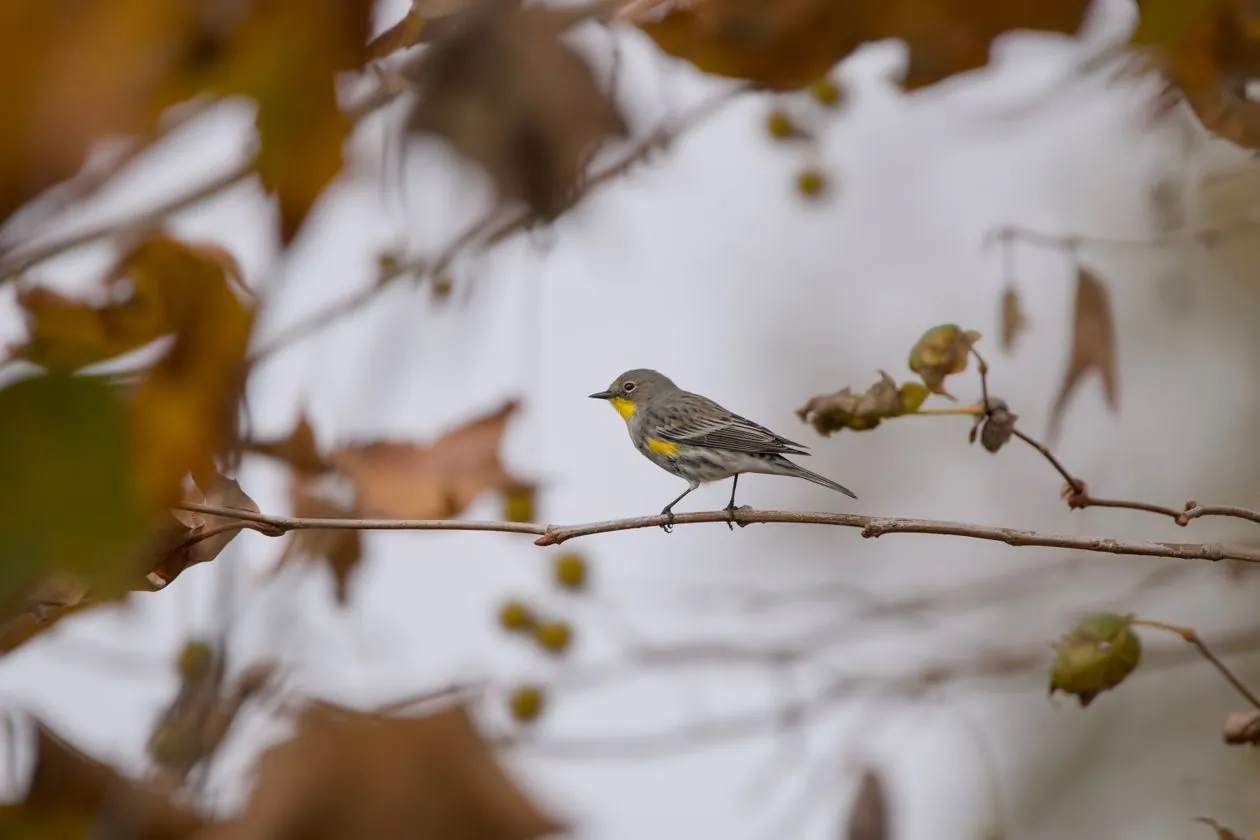
4. Over-relying on color in bad light. Backlit birds in a canopy look dark whatever their real colors. Switch to shape and pattern: bill size, tail length, wing bars, behavior. Silhouette ID is a learnable skill, and it is how hawk watchers work too, as our hawk identification chart shows for raptors.
5. Skipping the song. Many warblers are heard ten times for every good visual. Learning even five songs doubles your warbler list on a spring morning, and the mnemonic songs in the chart above genuinely stick.
Warbler Identification FAQs
What is the most common warbler in the United States?
The yellow-rumped warbler. It breeds across Canada and the northern US, migrates through nearly the entire country, and winters across the southern states, which means more birders see it, in more months, than any other warbler. The yellow warbler and common yellowthroat are close behind.

How do you tell warblers apart in the fall?
Focus on structure and the marks that do not molt away: wing bars, tail patterns, bill shape, and behavior. The confusing fall warblers (blackpoll, bay-breasted, pine) separate on leg color, streaking crispness, and bill thickness. Tail-pumping still means palm warbler, and white tail spots still mean magnolia.
Do warblers visit bird feeders?
Rarely. Warblers are insect eaters, so standard seed feeders do not interest them. A moving water drip draws warblers in during migration, and mealworms or suet can help in spring. Planting native shrubs and leaving brushy edges does far more than any feeder.

What is the smallest warbler in the US?
The Lucy’s warbler of the desert Southwest, at about 4 inches, with Wilson’s warbler close behind at 3.9 to 4.7 inches. Among the species in this chart, Wilson’s is the smallest, and its habit of flicking its wings and tail constantly is a good giveaway at any size.

The Bottom Line
Warbler identification stops feeling impossible the moment you switch from memorizing colors to reading marks in order: throat, head, wings, tail, behavior, habitat. Keep this warbler identification chart open on your phone during spring migration and work each bird through the table one column at a time. Within one season, the little yellow blur in the treetops will resolve into yellow warblers, magnolias, redstarts, and parulas. The same systematic approach works on our sparrow identification chart and our bird egg identification chart, which covers what those warblers leave behind in the nest.



Pingback: Bird Nest Identification Chart: Identify 20 Common US Nests by Sight – Chart Identify