
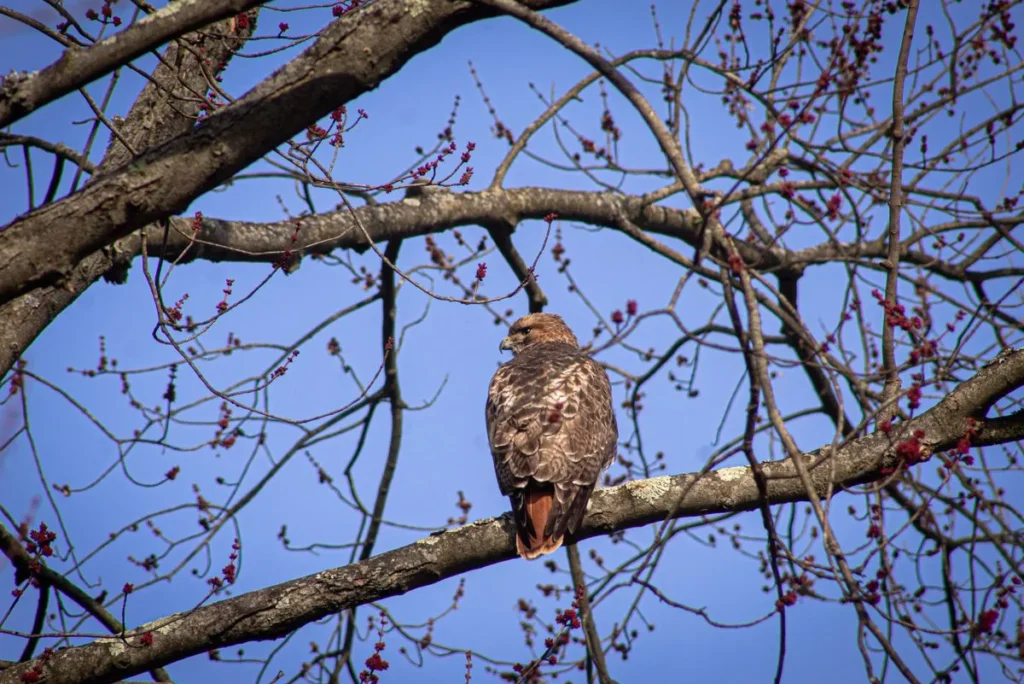
A big bird circles over a field, wings held in a shallow V, tail fanned wide. Is it a red-tailed hawk, a turkey vulture, or something rarer? This hawk identification chart gives you the fast answer, with wingspan, weight, tail pattern, habitat and flight style for 16 hawks you can actually see in the United States.
Hawks are daytime hunters with hooked bills, strong talons and eyesight that can spot a mouse from 100 feet up. Most US hawks fall into three groups. Buteos, like the red-tailed hawk, have broad wings and short tails built for soaring. Accipiters, like Cooper’s hawk, have short wings and long tails built for chasing birds through trees. Harriers hunt low over open ground. Learn the group first, then the chart will narrow it to one species.
The Complete Hawk Identification Chart
Lengths are from bill to tail tip. Weights are typical adult ranges, and females are larger than males in almost every species below, sometimes by a third. Use the chart to shortlist two or three candidates, then check the flight and tail sections that follow.
| Species | Scientific Name | Length | Wingspan | Weight | Best Field Mark | Habitat |
|---|---|---|---|---|---|---|
| Red-tailed Hawk | Buteo jamaicensis | 45 to 65 cm | 110 to 145 cm | 690 to 1600 g | Brick red tail in adults, dark belly band | Open country, deserts, field edges nationwide |
| Cooper’s Hawk | Astur cooperii | 35 to 50 cm | 62 to 94 cm | 220 to 680 g | Dark cap, rounded tail tip, blue gray back | Woodland, suburbs, backyard bird feeders |
| Sharp-shinned Hawk | Accipiter striatus | 24 to 34 cm | 43 to 56 cm | 82 to 220 g | Tiny size, squared tail tip, thin spindly legs | Dense forest, migration corridors |
| American Goshawk | Astur atricapillus | 53 to 69 cm | 103 to 117 cm | 630 to 1400 g | Bold white eyebrow stripe, slate gray above | Northern and mountain forest |
| Northern Harrier | Circus hudsonius | 43 to 54 cm | 97 to 122 cm | 290 to 530 g | Bright white rump patch, owl like face disc | Marshes, prairies, open fields |
| Red-shouldered Hawk | Buteo lineatus | 38 to 61 cm | 81 to 107 cm | 460 to 930 g | Rufous barred chest, black and white checkered wings | Wet woodland, river forest, swamps in the East and California |
| Swainson’s Hawk | Buteo swainsoni | 47 to 57 cm | 117 to 137 cm | 690 to 1400 g | Dark brown bib, pale belly, pointed wing tips | Western plains and prairies, migrates to Argentina |
| Broad-winged Hawk | Buteo platypterus | 34 to 44 cm | 81 to 100 cm | 265 to 560 g | One thick white band across a short tail | Eastern forest, huge fall migration kettles |
| Rough-legged Hawk | Buteo lagopus | 46 to 59 cm | 122 to 142 cm | 745 to 1660 g | Feathered legs down to the toes, dark belly patch | Arctic breeder, open country in winter in the northern US |
| Ferruginous Hawk | Buteo regalis | 50 to 69 cm | 133 to 152 cm | 970 to 2267 g | Largest US hawk, rusty back and legs, mostly white below | Western grassland, sagebrush and prairie dog towns |
| Harris’s Hawk | Parabuteo unicinctus | 46 to 59 cm | 103 to 120 cm | 530 to 1100 g | Chocolate brown with chestnut shoulders, white tail base and tip | Southwest deserts, hunts in family groups |
| Zone-tailed Hawk | Buteo albonotatus | 46 to 56 cm | 117 to 132 cm | 610 to 1080 g | Almost black, flies like a turkey vulture, one white tail band | Southwest canyons and desert mountains |
| Gray Hawk | Buteo plagiatus | 42 to 48 cm | 82 to 98 cm | 390 to 540 g | Solid gray above, finely barred below, bold black and white tail bands | Southern Arizona and Texas river woodland |
| White-tailed Hawk | Geranoaetus albicaudatus | 44 to 60 cm | 123 to 136 cm | 880 to 1230 g | Clean white tail with one black band near the tip, rusty shoulder patch | Texas and Gulf coastal prairie |
| Common Black Hawk | Buteogallus anthracinus | 43 to 53 cm | 102 to 127 cm | 630 to 1030 g | Sooty black all over, one wide white tail band, yellow legs | Southwest and Gulf streams with cottonwoods |
| Short-tailed Hawk | Buteo brachyurus | 39 to 44 cm | 83 to 103 cm | 342 to 580 g | Two colour forms, snow white or jet black below the wings, very short tail | Florida woodland edges, rare in south Texas and Arizona |
For a larger soaring bird with a fully feathered head and a wingspan over 180 cm, check our eagle identification chart instead, because eagles are often the other half of a hawk mix up.
How to Identify Hawks in Flight
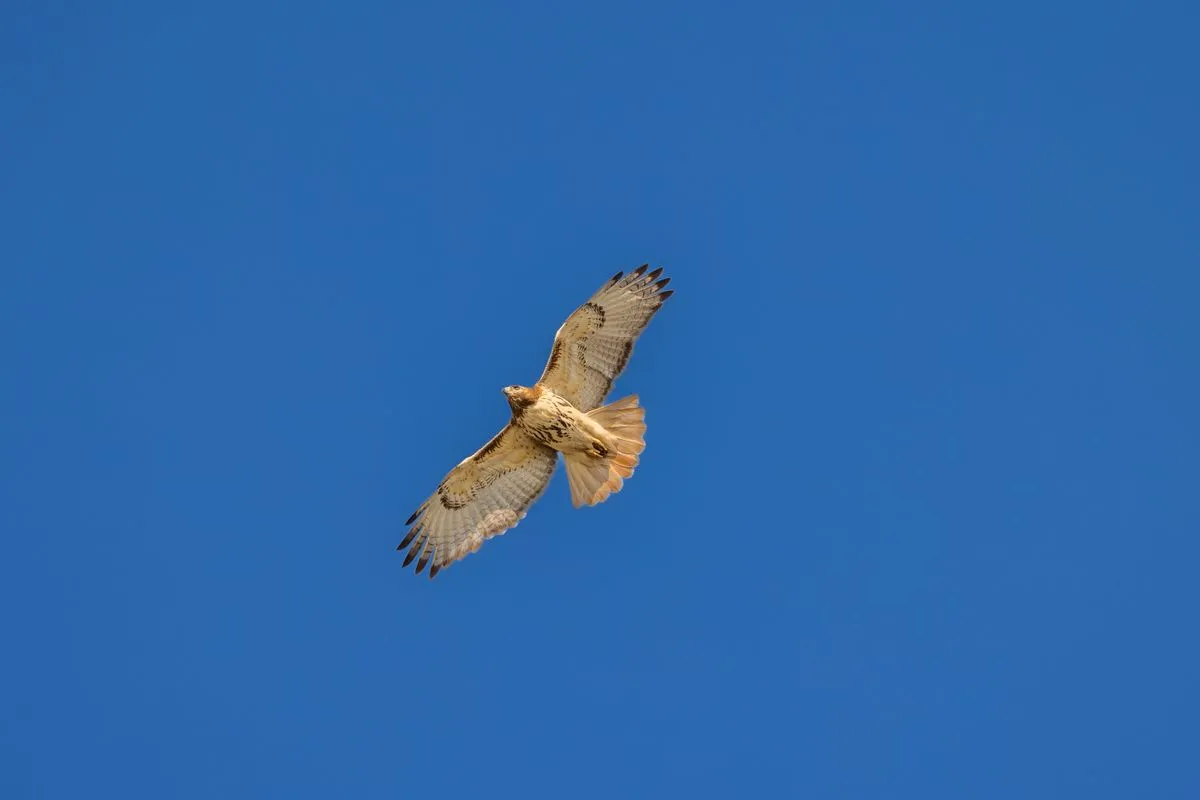
Flight style often gives a hawk away before you see any colour. Watch wing shape, wing position, and how often the bird flaps.
Buteos soar. Red-tailed, ferruginous and Swainson’s hawks hold broad wings flat or in a slight V and circle for minutes without a flap. Broad-winged hawks do the same in fall, in spinning flocks called kettles that can hold thousands of birds.
Accipiters flap and glide. Cooper’s and sharp-shinned hawks beat their short wings a few times, then glide straight and level. Their long tails steer them between tree trunks at full speed.
Harriers tilt. A northern harrier flies low over marsh grass, wings raised in a V, rocking side to side, then drops without warning onto a vole. Low, tilting, with a white patch at the base of the tail means harrier.

Identify Hawks by Tail Shape and Colour
The tail is the best clue on a soaring hawk, because it stays visible when underwing patterns wash out in bright sky.
An adult red-tailed hawk is easy: the upperside of the tail is warm brick red. A red-shouldered hawk shows many thin white bands on a dark tail. A broad-winged hawk shows the opposite, one or two thick white bands. Cooper’s hawk has a rounded tail tip with a wide white edge, while the near identical sharp-shinned hawk has a squared or notched tip, the first check on every accipiter. Count tail bands on the dark species: zone-tailed shows several thin bands plus one thick one, common black shows a single very wide white band.

The Two Hardest Pairs, Solved
Cooper’s Hawk vs Sharp-shinned Hawk
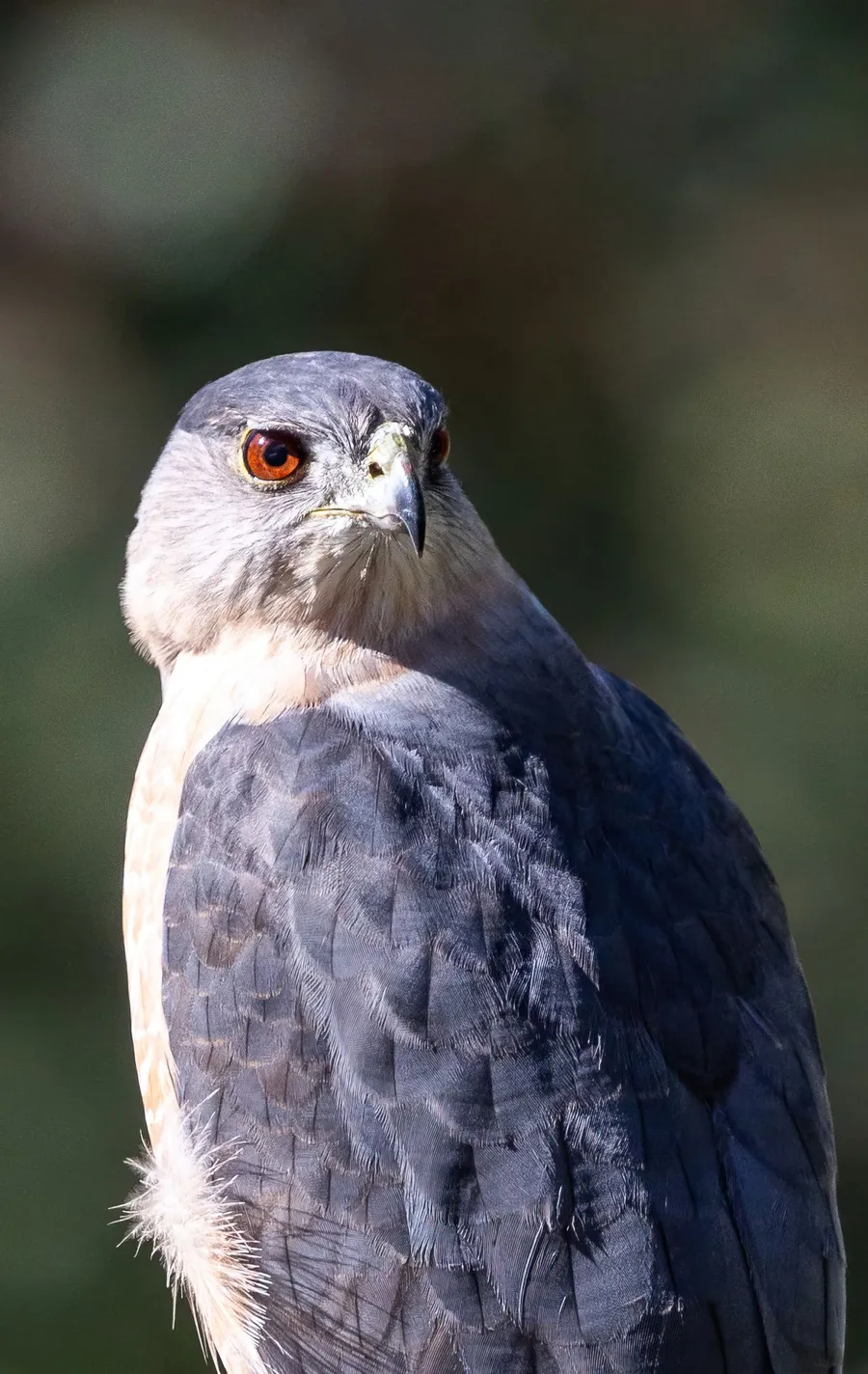
These two cause more arguments than any other US hawks. Size fools people, because a female sharp-shinned is close to a male Cooper’s. Use head and tail instead. Cooper’s has a larger head, a dark cap that contrasts with a paler neck, and a rounded tail tip. A sharp-shinned has a smaller, hooded looking head, dark colour wrapping down the neck, and matchstick legs. If the bird at your feeder looks barely bigger than a jay, it is almost certainly a sharp-shinned.
Red-tailed Hawk vs Ferruginous Hawk
Both are big western buteos, but the ferruginous is bulkier and paler underneath, with rusty feathered legs forming a dark V against a white belly in flight. A red-tailed shows a dark belly band of streaks and dark marks on the underwing leading edge.


Where and When to Look
Habitat cuts your list in half before you lift binoculars. Harriers belong to marshes and open fields. Gray hawks and common black hawks stick close to desert rivers in the far South. Goshawks stay in deep northern forest. Harris’s hawks perch in family groups on cactus tops and poles in the Southwest, and hunt together like a wolf pack, taking turns flushing prey.
Timing matters too. Rough-legged hawks are winter visitors from the Arctic. Swainson’s hawks leave each fall for a round trip of more than 22,000 km to Argentina. September and October are peak hawk watch season, when broad-winged, sharp-shinned and red-tailed hawks stream past counting stations by the thousand.
Smaller daytime hunters turn up in other charts too. For the night shift, see our owl identification chart, and for tiny backyard visitors our hummingbird identification chart is the quick reference most readers keep open.


Why So Many Hawks Look Brown and Streaky
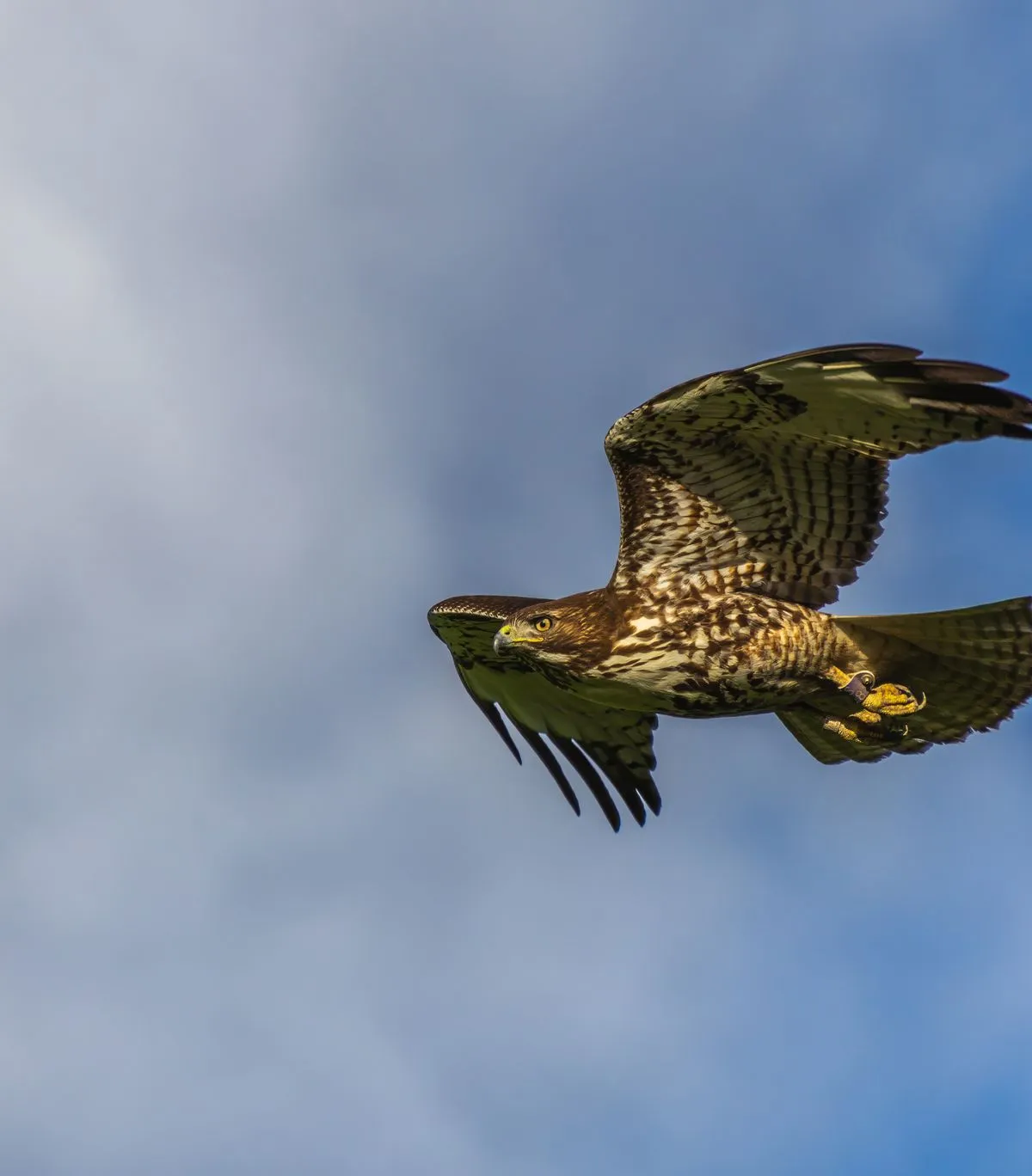
Young hawks wear a training uniform. In their first year, most buteos are brown above and pale with heavy streaks below, and a young red-tailed hawk has a brown, banded tail instead of the red one, which arrives at about two years old. Accipiters start with orange eyes that deepen to red with age. When a hawk refuses to match the chart, check its age first. Nine times out of ten, it is a young bird of a common kind.

Quick Hawk Identification Tips
Start with size: a crow is about 45 cm long, so a hawk clearly larger is a buteo, and one clearly smaller is likely a sharp-shinned.
Look at the perch. Bird hunting hawks sit inside tree cover. Rodent hunters sit on poles, posts and bare snags in the open.
Listen. Red-shouldered hawks give loud, whistled kee-yer calls. Red-tailed hawks give the harsh scream that movies wrongly paste onto eagles.
Photograph first, identify second. A phone shot through binoculars freezes tail bands and wing shape you can check against the chart at home. If you find a grounded hawk, do not handle it: a licensed wildlife rehabilitator is the right call.
Hawks also share their ground with mammal hunters. Our all fox species chart shows the other predators working the same fields at ground level.


Frequently Asked Questions
What is the most common hawk in the United States?
The red-tailed hawk. It lives in every state, perches on highway poles across the country, and adapts to deserts, farmland and city parks. If you see one large hawk on a road trip, it is most likely this species.
How can I tell a hawk from a falcon?
Falcons have long, pointed wings, fast and stiff wingbeats, and a notched bill. Hawks have broader, rounded or fingered wings, soar far more, and kill mainly with their feet. A bird hanging in circles on flat wings is a hawk, not a falcon.
What is the largest hawk in North America?
The ferruginous hawk, at up to 69 cm long with a wingspan near 152 cm and a weight that can pass 2 kg. The rough-legged hawk is close in wingspan but lighter.
Are hawks dangerous to backyard chickens or small pets?
Hawks do take free range chickens, and Cooper’s hawks specialise in birds. Small pets are rarely targeted by buteos, which prefer rodents. Cover for chickens at dawn and dusk removes most risk. Hawks are protected by federal law.
Why do hawks circle in the sky?
They are riding thermals, columns of warm rising air that lift them with almost no effort. Circling lets a hawk climb high, scan a huge area for prey, and travel long distances during migration while barely flapping.
Conclusion
Hawk identification is a habit, not a talent: group first (buteo, accipiter or harrier), then tail, then one strong field mark from the chart. Keep this chart saved, and those circling silhouettes will turn into named birds faster than you expect.


Pingback: Warbler Identification Chart: Identify 20 Common US Warblers by Sight – Chart Identify
Pingback: Hawk Feather Identification Chart: Identify 12 Species by Feather – Chart Identify