
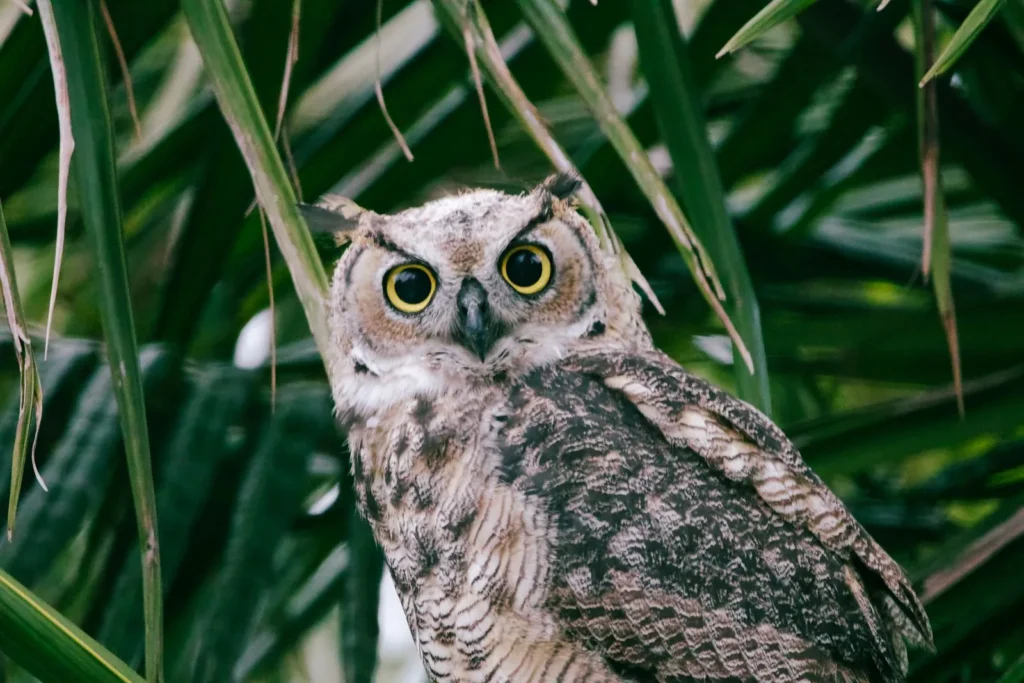
Spotting an owl in the wild is one of the best moments in birding, but figuring out which owl you are looking at is a different skill. This owl identification chart covers 19 common US owls with the details that matter in the field: real sizes, ranges, calls, and the one field mark that separates each species from its lookalikes.
Owls are easier to identify than most people expect once you know what to check first. Start with size, then the eyes and head shape, then listen. A large tufted owl in the suburbs is almost always a great horned owl. A medium brown owl with dark eyes in an eastern forest is almost always a barred owl. The table below turns those instincts into a reliable system.

Owl Identification Chart: 19 Common US Owls
Use this chart as your quick reference. Length is bill to tail tip. The “key ID feature” column gives the single fastest way to confirm each species.
| Species | Scientific Name | Length | Wingspan | US Range | Key ID Feature |
|---|---|---|---|---|---|
| Great Horned Owl | Bubo virginianus | 18-25 in | 40-55 in | All 50 states | Tall ear tufts, yellow eyes, white throat patch |
| Barn Owl | Tyto alba | 13-15 in | 31-37 in | Nationwide, scarce in the North | Heart-shaped white face, no ear tufts, dark eyes |
| Eastern Screech-Owl | Megascops asio | 6-10 in | 18-24 in | East of the Rockies | Small ear tufts, whinnying trill call |
| Western Screech-Owl | Megascops kennicottii | 7-10 in | 20-24 in | Western states | Small ear tufts, bouncing-ball call |
| Barred Owl | Strix varia | 17-20 in | 38-49 in | Eastern US, expanding into the Pacific Northwest | Round head, dark eyes, “who cooks for you” call |
| Great Gray Owl | Strix nebulosa | 24-33 in | 54-60 in | Northern forests, Rockies, Sierra Nevada | Tallest US owl, yellow eyes, white “bow tie” under bill |
| Snowy Owl | Bubo scandiacus | 20-28 in | 49-57 in | Arctic; winters in northern states | Mostly white plumage, yellow eyes, hunts by day |
| Burrowing Owl | Athene cunicularia | 7-10 in | 20-24 in | Western and southern grasslands | Long legs, lives in ground burrows, active by day |
| Northern Saw-whet Owl | Aegolius acadicus | 7-8.5 in | 16-22 in | Forests across North America | Tiny, yellow eyes, repeated tooting whistle |
| Northern Pygmy-Owl | Glaucidium gnoma | 6-7.5 in | 14-16 in | Western mountains | Diurnal, false “eyes” on back of head |
| Short-eared Owl | Asio flammeus | 13-17 in | 33-40 in | Open country nationwide | Moth-like floppy flight over fields at dusk |
| Long-eared Owl | Asio otus | 13-16 in | 35-39 in | Nationwide in dense thickets | Long close-set ear tufts, orange facial disc |
| Spotted Owl | Strix occidentalis | 16-19 in | 40-45 in | Old-growth forests of the West | Dark eyes, white spots (not bars) on brown body |
| Elf Owl | Micrathene whitneyi | 5-6 in | 13-15 in | Southwest deserts | Smallest US owl, no ear tufts, nests in cactus holes |
| Flammulated Owl | Psiloscops flammeolus | 6-7 in | 14-16 in | Western pine forests | Dark eyes, reddish plumage, single low hoot |
| Boreal Owl | Aegolius funereus | 8-11 in | 21-24 in | Northern forests, high Rockies | White-spotted forehead, yellow eyes, square head |
| Northern Hawk Owl | Surnia ulula | 14-17 in | 27-33 in | Northern tier, Alaska, Canada border | Long tail, hawk-like posture, hunts by day |
| Whiskered Screech-Owl | Megascops trichopsis | 6-8 in | 16-18 in | Southeast Arizona mountains | Morse-code-like series of hoots |
| Ferruginous Pygmy-Owl | Glaucidium brasilianum | 6-7 in | 14-16 in | South Texas, southern Arizona | Rusty brown, streaked crown, fierce daytime hunter |
How to Use This Owl Identification Chart: 5 Field Marks
The table gives you the facts, but in the field you will rarely see an owl sitting still in good light. These five field marks are what experienced birders check.
1. Size first, always
Size is the fastest filter. Bigger than a crow means great horned, barred, great gray, or snowy. Sparrow to robin sized means screech-owl, pygmy-owl, saw-whet, elf, or flammulated. Everything in between narrows to barn, short-eared, long-eared, spotted, or hawk owl.

2. Ear tufts: present or absent
Ear tufts are just feathers, not ears, but they split the owl world in two. Tufted owls include the great horned, both screech-owls, and the long-eared. Tuftless owls include the barn, barred, spotted, great gray, snowy, and burrowing. If you see no tufts, you have already eliminated half the chart.
3. Eye color
Owl eye color is consistent within a species and easy to see with binoculars. Yellow eyes point to great horned, snowy, great gray, burrowing, saw-whet, or boreal. Dark eyes point to barred, spotted, barn, flammulated, or elf. Orange eyes are the specialty of the long-eared owl. This one mark resolves the classic barred versus great horned confusion instantly: barred owls have dark eyes, great horned owls have yellow ones.

4. Face shape
The barn owl’s heart-shaped white face belongs to no other US owl. The great gray owl has the largest, most perfectly round facial disc of any owl. Screech-owls have a neat round face with bold white eyebrows.
5. Behavior and habitat
Where and when you see the owl is a genuine ID clue. An owl standing on the ground in a prairie dog town is a burrowing owl. An owl hunting over a marsh at dusk with floppy wingbeats is a short-eared owl. A tiny owl on a saguaro in Arizona is an elf owl. Snowy, burrowing, pygmy, and hawk owls hunt in daylight, while most others are strictly nocturnal. If you enjoy this step-by-step ID system, our duck identification chart works the same way for waterfowl.
Identifying Owls by Their Calls
Most owls are heard more often than seen, so learning calls doubles your ID success. Each species below has its classic vocalization written out the way birders remember it.
- Great Horned Owl: deep, stuttering hoots: “hoo-h’HOO-hoo-hoo.” Pairs often duet, the male lower than the female.
- Barred Owl: the famous eight-note “who cooks for you, who cooks for you-all,” last note drawn out. Learn this one first.
- Eastern Screech-Owl: a descending whinny like a tiny horse, sometimes ending in a soft trill. Nothing like a hoot.
- Western Screech-Owl: an accelerating series of short hoots like a bouncing ball coming to rest.
- Barn Owl: no hoot at all. A long, raspy shriek that startles everyone the first time they hear it.
- Great Gray Owl: deep, soft, widely spaced hoots: “whooo… whooo… whooo.”
- Burrowing Owl: a gentle two-note “coo-coooo.” Chicks make a rattlesnake-like buzz to scare predators from the burrow.
- Northern Saw-whet Owl: an endlessly repeated single “toot,” sometimes hundreds of times in a row.

Two practical tips. First, owls call most from late winter through spring when setting up territories, and go quiet in summer. Second, learn your state’s common species first. In most of the eastern US, a mystery hoot is a great horned or barred owl nine times out of ten. Our hummingbird identification chart takes the same call-first approach for another tricky group.

Size Shortcuts: Small, Medium, and Large US Owls
When a birder says “it was a small owl,” they usually mean something in the 5 to 8 inch range, and that instantly limits the options. Here is how the size groups break down.
Tiny owls (5-8 inches): elf owl, flammulated owl, northern pygmy-owl, ferruginous pygmy-owl, whiskered screech-owl, and northern saw-whet owl. All could hide behind a coffee mug. The elf owl is the smallest US owl at barely 5 inches and lives only in the desert Southwest. Saw-whets are the tiny owl most people actually encounter, often roosting low in dense evergreens in winter.
Medium owls (13-20 inches): barn owl, short-eared owl, long-eared owl, spotted owl, northern hawk owl, and barred owl. This is the confusing middle. Remember: dark eyes plus round head means barred or spotted, yellow eyes plus tufts on a crow-sized bird means long-eared.

Large owls (20+ inches): great horned owl, snowy owl, and great gray owl. The great gray is the tallest owl in North America at up to 33 inches, though much of that is feathers and it weighs less than a great horned. Snowy owls are the heavyweights, with females topping 4 pounds.

Common Owl Identification Mistakes
Barred owl versus spotted owl. The hardest pair on this chart. Both have round heads, dark eyes, and brown plumage. The difference: barred owls have horizontal barring across the chest that turns to vertical streaks below, while spotted owls have white spots all over. Range helps too, since spotted owls live only in western old-growth forest.
Great horned owl versus long-eared owl. Both are tufted with yellow eyes, but the size gap is huge. A long-eared owl is crow sized and slender with an orange face; a great horned owl is bulky, barrel chested, and twice the weight. If it looks big, it is not a long-eared.

Screech-owl versus saw-whet owl. Screech-owls have ear tufts and saw-whets do not. Saw-whets also have a big-headed, kitten-like look with a heavily streaked chest.
Calling every large owl a “hoot owl.” “Hoot owl” is not a species. Assuming every hoot is a great horned owl misses barred owls, now the more common backyard owl across much of the East. Learn the “who cooks for you” rhythm and you will start hearing barred owls everywhere.

Owl Identification FAQs
What is the easiest owl to identify in the US?
The barn owl, thanks to its heart-shaped white face, which no other North American owl has. The snowy owl is a close second. Beginners should start with these two and the barred owl’s famous call.
How can you tell a male owl from a female owl?
By sight alone, you usually cannot. Male and female owls look nearly identical, though females are often noticeably larger. The reliable difference is voice: in great horned owl pairs, the male hoots lower and the female answers higher.

What owl is most common in backyards?
In the eastern US it is the barred owl, which has adapted well to suburban woods and is often heard before it is seen. In the West, the great horned owl rules the suburbs and will nest in large neighborhood trees.

Can you identify an owl just by its pellets?
Pellets tell you what the owl ate, not which owl it was, but they narrow it down. Barn owl pellets are typically packed with vole and mouse skulls, while great horned owl pellets often contain larger prey like skunk remains. Combine pellet clues with the habitat for a strong guess.
Conclusion
Owl identification gets much easier once you work the field marks in order: size, ear tufts, eye color, face shape, then behavior and voice. This chart puts all 19 common US owls side by side so you can compare the confusing pairs directly. Start with the owls in your own state and learn two or three calls cold.

Keep this owl identification chart bookmarked for your next evening outdoors, and share it with anyone who has ever asked “what owl was that?” If you keep pet or garden birds too, our budgie color chart is a handy companion.


Pingback: Bird Egg Identification Chart: Identify 20 Common US Species – Chart Identify
Pingback: All Wolf Species: Complete Chart of Size, Range and Facts – Chart Identify
Pingback: Types of Owls: 16 Species, Sizes, Habitats and Identification – Chart Identify
Pingback: Types of Birds: 20 Species, Sizes and Habitats – Chart Identify
Pingback: Owl Egg Identification Chart: Identify 12 Common US Owls by Egg – Chart Identify
Pingback: Eagle Feather Identification Chart: Identify 12 Species by Feather – Chart Identify
Pingback: Owl Feather Identification Chart: Identify 12 Species by Feather – Chart Identify