
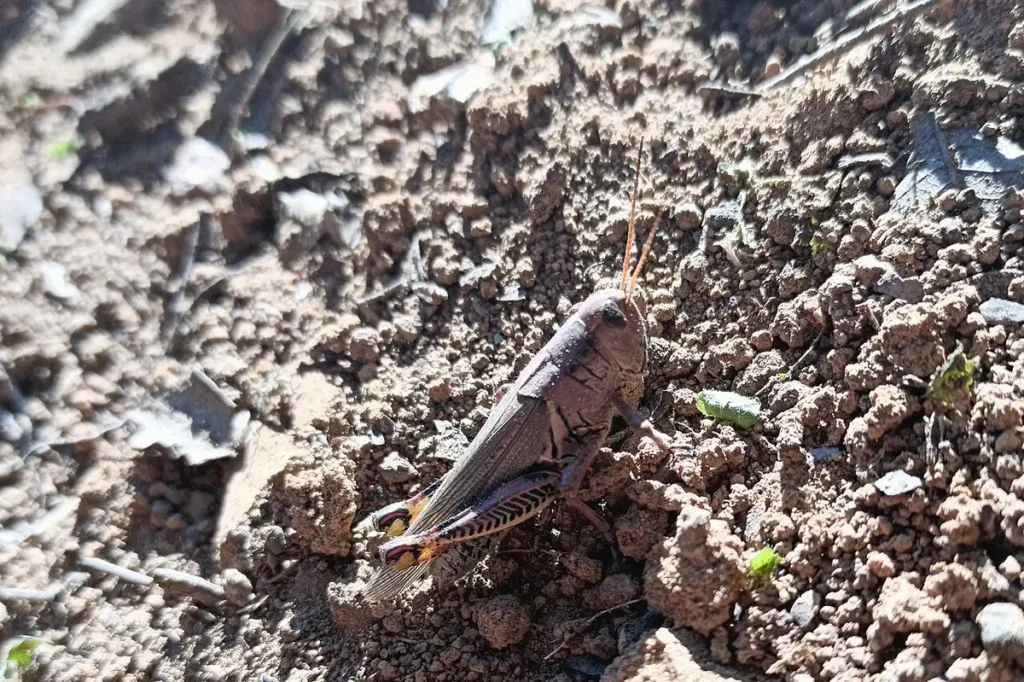
Stand in a summer field and the grass seems to jump by itself. Most of those jumpers get one label, grasshopper, but the types of grasshoppers around you could belong to dozens of different species. Scientists count more than 11,000 grasshopper species worldwide. Some are barely a centimeter long and hide in wet moss. Others are heavy, brightly colored insects the size of your thumb. A few, when crowds build up, change into locusts and travel in swarms that darken the sky. This chart covers the 20 best known species, with sizes, colors, habitats, and the one feature that gives each away, so you can put a name to the insect on your porch, your lawn, or your windshield.
If the insect you found has long, thread-like antennae and sings at night, it is probably not a grasshopper at all. Compare it with the species in our types of crickets chart before you start here.
The Types of Grasshoppers Chart: 20 Species Compared
Nearly every species below belongs to the short-horned grasshopper family, Acrididae, named for the short, thick antennae. The pygmy grasshoppers are the exception, sitting in their own family, Tetrigidae. Sizes are adult body lengths, and females are usually the larger sex.
| # | Species | Scientific Name | Size | Where It Lives | Key ID Feature |
|---|---|---|---|---|---|
| 1 | Differential Grasshopper | Melanoplus differentialis | 1.1 to 1.7 in (28 to 43 mm) | Fields, farms, gardens across North America | Yellow hind legs with black herringbone stripes |
| 2 | Red-Legged Grasshopper | Melanoplus femurrubrum | 0.7 to 1.1 in (18 to 28 mm) | Meadows and crops, most of North America | Bright red hind legs |
| 3 | Two-Striped Grasshopper | Melanoplus bivittatus | 1.2 to 1.9 in (30 to 48 mm) | Grasslands and roadsides, northern US and Canada | Two pale stripes running from the eyes to the wing tips |
| 4 | Migratory Grasshopper | Melanoplus sanguinipes | 0.8 to 1.2 in (20 to 30 mm) | Prairies and farmland, western and central North America | Reddish hind legs, famous crop pest |
| 5 | Devastating Grasshopper | Melanoplus devastator | 0.7 to 1.1 in (18 to 28 mm) | Dry grasslands of the western US | Pale body with a dark stripe behind the eye |
| 6 | Carolina Grasshopper | Dissosteira carolina | 1.2 to 1.8 in (30 to 45 mm) | Dry, bare ground and dirt roads, most of North America | Black hind wings with a pale border, flashes like a butterfly |
| 7 | Clear-Winged Grasshopper | Camnula pellucida | 0.8 to 1.2 in (20 to 30 mm) | Open grassland, northern US and Canada | Clear hind wings and mottled brown camouflage |
| 8 | Crackling Forest Grasshopper | Trimerotropis verruculata | 0.9 to 1.4 in (23 to 36 mm) | Forest edges and rocky ground, northern North America | Crackles loudly in flight over the trees |
| 9 | Kiowa Grasshopper | Trachyrhachys kiowa | 0.8 to 1.3 in (20 to 33 mm) | Shortgrass prairie, Great Plains | Pale yellow-green body, crackling flight |
| 10 | Green-Striped Grasshopper | Chortophaga viridifasciata | 0.8 to 1.2 in (20 to 30 mm) | Moist meadows, eastern and central North America | Males brown, females bright green with a pale stripe |
| 11 | Short-Winged Green Grasshopper | Dichromorpha viridis | 0.6 to 1.1 in (15 to 28 mm) | Damp grass and lawns, eastern US | Short wings that never cover the abdomen |
| 12 | Admirable Grasshopper | Syrbula admirabilis | 0.8 to 1.3 in (20 to 33 mm) | Tall grass, southern US and Mexico | Slanted face and bold black and white leg bands |
| 13 | American Grasshopper | Schistocerca americana | 1.5 to 2.2 in (38 to 55 mm) | Fields and citrus groves, southeastern US | Large reddish brown body, strong flier |
| 14 | Desert Locust | Schistocerca gregaria | 1.6 to 2.4 in (40 to 60 mm) | Deserts and dry grasslands of Africa and Asia | Turns yellow and black and swarms when crowded |
| 15 | Bird Grasshopper | Schistocerca nitens | 1.7 to 2.6 in (43 to 66 mm) | Deserts and scrub, southwestern US and Mexico | Long wings, flies up into trees like a small bird |
| 16 | Eastern Lubber Grasshopper | Romalea microptera | 1.7 to 3.1 in (43 to 79 mm) | Wet lowlands, southeastern US | Huge black body with yellow, orange, and red marks |
| 17 | Plains Lubber Grasshopper | Brachystola magna | 1.6 to 2.4 in (40 to 60 mm) | Great Plains grassland | Stocky pinkish brown body, wings too short to fly |
| 18 | Rainbow Grasshopper | Dactylotum bicolor | 0.8 to 1.4 in (20 to 35 mm) | Shortgrass plains, southwestern US and Mexico | Painted in blue, red, orange, and black |
| 19 | Ebony Grasshopper | Boopedon nubilum | 0.7 to 1.2 in (18 to 30 mm) | Prairies, central US | Males almost jet black, females brown |
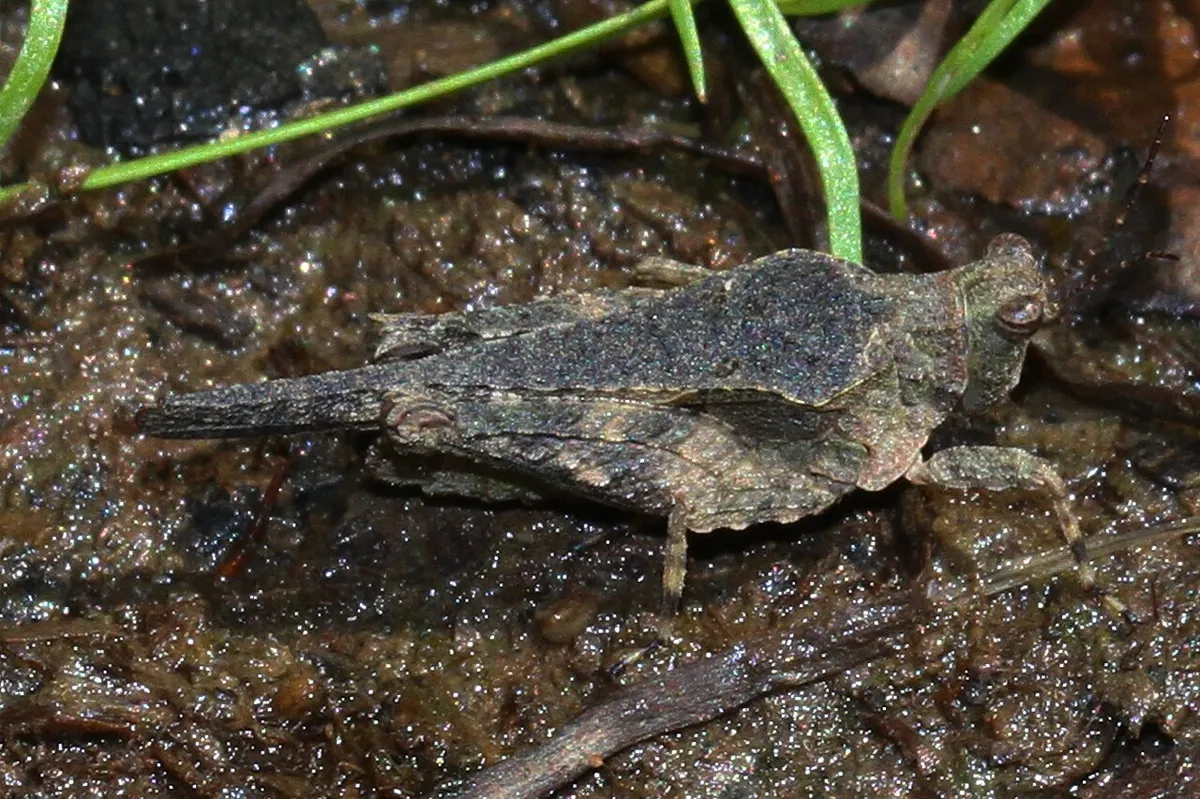
| 20 | Pygmy Grasshopper | Tetrix subulata | 0.3 to 0.6 in (8 to 15 mm) | Wet soil, pond edges, and moss, northern hemisphere | Tiny body with a long shield covering the whole back |

Spur-Throated Grasshoppers: The Melanoplus Group
The biggest family group on this chart is the spur-throated grasshoppers, subfamily Melanoplinae. Each carries a small spine, the spur, between its front legs. The genus Melanoplus alone holds most of the grasshoppers that eat North American gardens and crops.
The differential grasshopper is the big yellow-green one that piles onto bean rows and tomato plants in late summer. Look at the hind legs: the black stripes form a herringbone pattern you can spot across the garden. The red-legged grasshopper is smaller and far more common. True to its name, its hind legs are a clear, bright red, and it turns up in almost every meadow on the continent. The two-striped grasshopper is a northern species with two pale stripes that run unbroken from behind each eye to the tips of the wings. It feeds heavily on grasses and broadleaf weeds along roadsides.
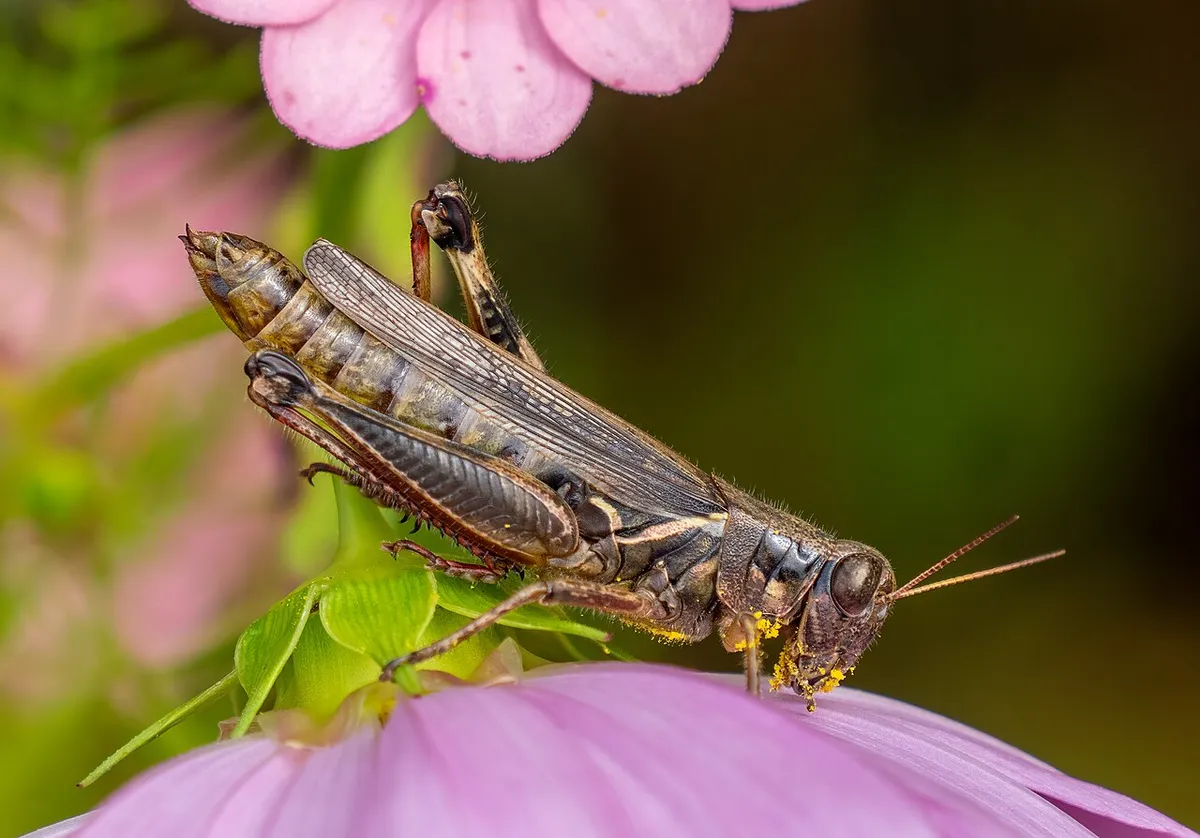
Two Melanoplus species carry their reputation in their names. The migratory grasshopper has damaged prairie crops for over a century. It eats an unusually wide range of plants and builds up in huge numbers in dry years. The devastating grasshopper is its western partner, a dry-grassland species that outbreaks on rangeland in California and the Great Basin. Both are plain, mottled insects. Their damage, not their looks, made them famous.
Band-Winged Grasshoppers: Masters of Camouflage
Band-winged grasshoppers (subfamily Oedipodinae) spend most of their lives invisible. Their forewings match gravel, sand, and dry soil almost perfectly. Then they fly, and the hidden hind wings flash out: black, yellow, red, or clear, often with a crackling sound called crepitation. Predators that chase the flash land where the insect folded its wings and vanished.
The Carolina grasshopper is the species most people have seen without knowing it. It sits on dirt roads and bare field edges all across North America, and when it takes off, its black hind wings with their pale cream border make it look like a mourning cloak butterfly. The clear-winged grasshopper is a serious grassland pest in Canada and the northern states, named for hind wings as transparent as cellophane. The crackling forest grasshopper lives along woodland edges and announces itself with loud snaps as it flies between the trees. The Kiowa grasshopper does the same trick over shortgrass prairie, flashing pale wings above the buffalo grass.

Slant-Faced Grasshoppers: The Quiet Grass Dwellers
Slant-faced grasshoppers (subfamily Gomphocerinae) have long, angled faces that slope back from the eyes, no throat spur, and slim bodies built to disappear among grass stems. They rarely damage crops. Most feed low in moist meadows, where their soft songs are easy to miss.
The green-striped grasshopper is one of the first grasshoppers active in spring, and it breaks the usual rule: males are mostly brown, while females are leaf green with a pale stripe down the back. The short-winged green grasshopper is a lawn and damp-meadow regular in the eastern states. Its wings are so short they never reach the end of the body, so it relies on jumping and hiding instead of flight. The admirable grasshopper, a southern species, is the showpiece of the group, with a sharply slanted face and black and white banded legs.

Locusts and Bird Grasshoppers: The Schistocerca Group
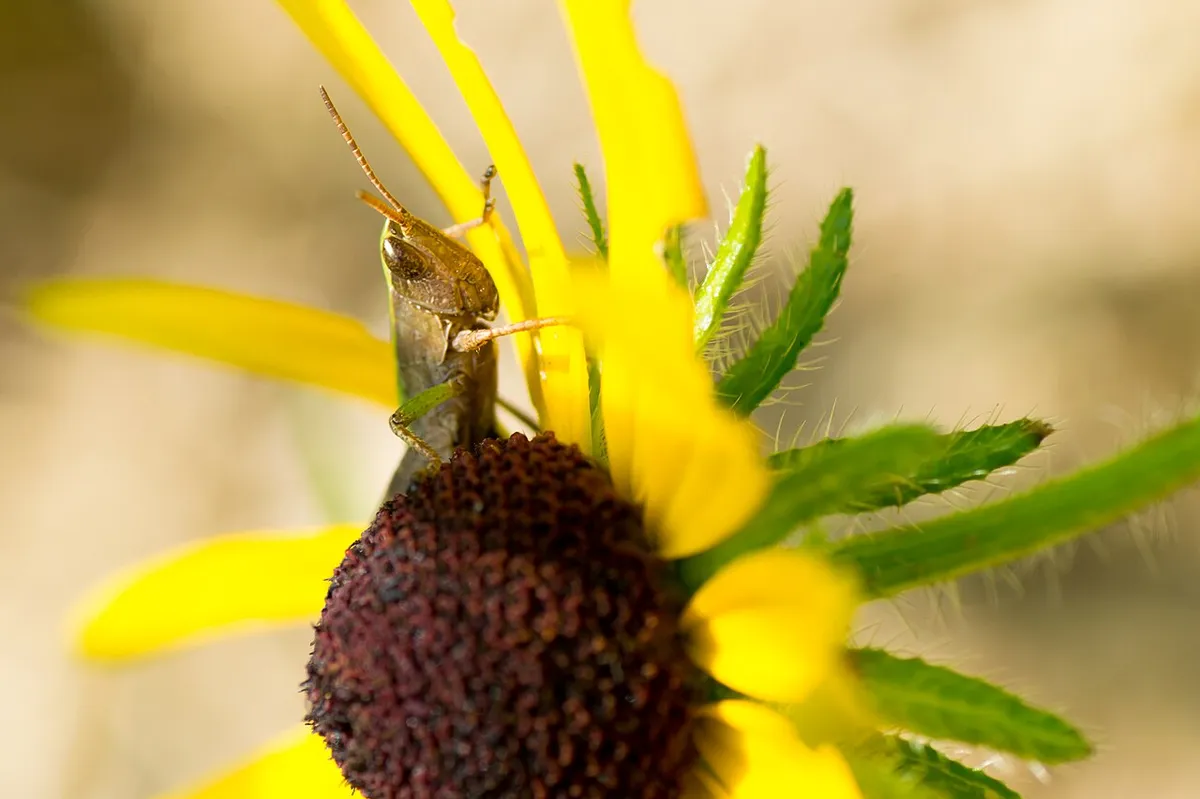
The genus Schistocerca holds the strongest fliers on this chart, including the only true locusts. The American grasshopper is a big reddish brown insect of the Southeast, common around citrus groves and weedy fields, and a strong, high flier for its size. The bird grasshopper of the Southwest goes further: startled from desert scrub, it launches upward and lands in a tree, which is exactly how it earned its name.
The desert locust is the species behind the plagues of history. Alone, it is a shy, greenish insect of African and Asian drylands. When rain produces lush growth and crowds form, the young change color to yellow and black, gather by the billion, and migrate hundreds of miles. A large swarm can eat its own weight in plants every day. Nothing else on this list, and no other grasshopper on Earth, changes its whole way of life this way.


Lubbers and the Rainbow Grasshopper: Big, Slow, and Toxic
Lubber grasshoppers (family Romaleidae) gave up on flying. They are heavy, slow walkers with short wings, and they defend themselves with chemistry instead. The eastern lubber is the giant of this chart, reaching three inches, dressed in black with yellow, orange, and red markings. When threatened it hisses, spreads its small bright wings, and releases a foamy, foul-tasting spray. Birds that try one usually do not try a second. The plains lubber is the western version, a stocky pinkish brown grasshopper of the Great Plains that can barely get off the ground.
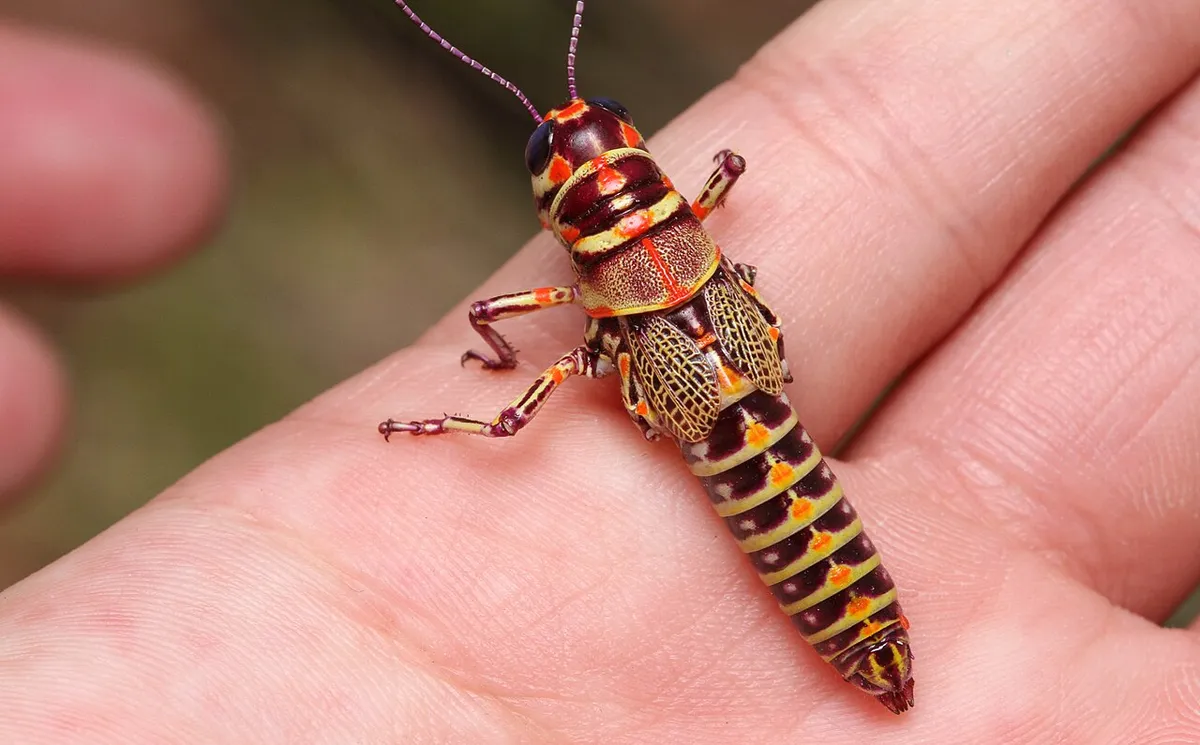
The rainbow grasshopper uses the same strategy at a smaller size. Its blue, red, orange, and black paint job warns predators that it feeds on toxic plants and tastes terrible. The ebony grasshopper is the opposite approach: males are nearly jet black and warm up fast in the prairie sun, while the brown females stay hidden in the grass. For another brightly patterned insect group with warning colors, see our types of butterflies chart.
Pygmy Grasshoppers: The Tiny Outliers
Pygmy grasshoppers (family Tetrigidae) are easy to walk past. Most are under half an inch long, colored like mud and leaf litter, and live on wet soil at the edges of ponds and streams, where they graze on algae and moss. Their giveaway is the pronotum, the shield behind the head, which stretches back over the entire body like a pointed hood. Tetrix subulata is one of the most widespread, found across the northern hemisphere. If small jumping insects are your puzzle, our crickets chart and the beneficial insects chart cover the other common lookalikes.
How to Identify a Grasshopper in the Field
You do not need a net or a microscope. Work through these checks in order.
1. Check the antennae. Short and thick, shorter than the body, means grasshopper. Long and thread-like means cricket or katydid.
2. Watch it fly. A flash of colored hind wings points to the band-winged group. A short, weak flutter from a heavy body suggests a lubber.
3. Look at the face. A slanted, pointed face means a slant-faced grasshopper. A vertical face with a tiny spur under the chin means a spur-throated species.
4. Read the legs. Red hind legs, striped hind legs, and banded legs narrow the list fast. Leg color is the fastest field mark on most Melanoplus species.
5. Note the size and the place. A three-inch grasshopper in a Florida wetland can only be an eastern lubber. A half-inch one on pond mud is a pygmy.


Are Grasshoppers Harmful?
Not to people. Grasshoppers cannot sting, they have no venom, and they almost never bite. A big lubber may pinch lightly or release a drop of brown defensive fluid, often called tobacco juice, which is harmless. The real harm is to plants. In ordinary years grasshoppers are grassland food for birds, lizards, and spiders, and they do little damage. In outbreak years, species like the migratory and clear-winged grasshoppers can strip gardens and rangeland, and desert locust swarms remain a genuine threat to farms across Africa and Asia. Two species on this chart, the eastern lubber and the rainbow grasshopper, are toxic to eat, so keep dogs from crunching them, but they are perfectly safe to watch and photograph.
Frequently Asked Questions
How many types of grasshoppers are there?
More than 11,000 species are known worldwide. Most belong to the short-horned family Acrididae. The main groups are the spur-throated, band-winged, and slant-faced grasshoppers, plus the lubbers and the tiny pygmy grasshoppers.
What is the biggest grasshopper in the United States?
The eastern lubber is the largest common US species, reaching about three inches long. It is heavy, slow, and nearly flightless, and it lives in the wet lowlands of the Southeast.
What is the difference between a grasshopper and a locust?
A locust is a grasshopper that swarms. A few species, led by the desert locust, change color and behavior when crowded, gathering into migrating swarms. The same species lives quietly and alone when numbers are low.
How can I tell a grasshopper from a cricket?
Check the antennae and the clock. Grasshoppers have short, thick antennae and feed by day. Crickets have long, thread-like antennae and sing at night. Grasshoppers also make sound by rubbing a hind leg against the wing.
Do grasshoppers bite people?
No. Grasshoppers do not bite or sting people and carry no venom. A large one may pinch if grabbed, and some release a harmless brown fluid as a defense.
Conclusion
The word grasshopper covers far more variety than most people expect: herringbone-legged crop eaters, butterfly-winged roadside fliers, a rainbow warning sign on legs, and a desert species that can turn into a plague. Start with the antennae, the flight, the face, and the legs, and the 20 species on this chart will sort themselves out quickly. The next time the grass jumps around you, slow down. One of these names is probably hopping past.


Pingback: Types of Weevils: 20 Species, Sizes and Habitats – Chart Identify