

This fly identification chart helps you name the fly in front of you, whether it is circling a fruit bowl, fluttering around a bathroom drain, or landing on your arm at a picnic. The United States is home to thousands of fly species, but the 20 in this chart cover nearly every fly an American homeowner, gardener, or hiker will ever meet. You rarely need a microscope: size, color, where you found it, and whether it bites will narrow the list to one or two names in under a minute.

How to Identify a Fly in 5 Steps
1. Size. Judge the fly against something familiar. A fruit fly is about 3 mm long, close to a sesame seed. A house fly is 6 to 7 mm. A horse fly can reach 25 mm, the width of a quarter. Size alone rules out half the chart.
2. Color and shine. Most pest flies are dull gray or brown. Blow flies are not: they glow metallic green, blue, or copper in sunlight. Stripes matter too. Four dark stripes on the thorax point to a house fly; three stripes plus red eyes point to a flesh fly.
3. Eyes. A fly’s eyes take up most of its head, and they carry real clues. Huge eyes with swirling patterns belong to horse flies and deer flies. Bright red eyes show up on house flies, fruit flies, and flesh flies.
4. Wings. True flies have only ONE pair of wings. Bees and wasps have two pairs, so a quick wing count settles most arguments. At rest, house flies hold their wings flat over the back, while drain flies hold theirs up like a little roof and look fuzzy, almost like tiny moths.
5. Place and behavior. Location is often the whole answer. Tiny flies over bananas are fruit flies. Tiny flies at a shower drain are drain flies. Slow flies gathering at a sunny window in October are cluster flies. A fly that hovers perfectly still in front of a flower, then darts sideways, is a hoverfly.

Fly Identification Chart: 20 Common US Flies
Use this table as your first stop. Match size and color first, check the habitat column, then read the matching section below for the fine details and what to do about it.
| Fly | Size | Color and markings | Where you find it | Bites people? |
|---|---|---|---|---|
| House Fly | 6-7 mm | Gray, 4 dark stripes on thorax, red eyes | Kitchens, trash cans, food areas | No |
| Fruit Fly | 3-4 mm | Tan to yellow-brown, red eyes | Fruit bowls, drains, compost, recycling bins | No |
| Drain Fly | 2-5 mm | Gray-brown and fuzzy, moth-like heart-shaped wings | Bathroom drains, shower grout, wet mops | No |
| Phorid Fly | 2-4 mm | Brown, strongly humpbacked thorax | Trash, sewers, decaying matter, broken pipes | No |
| Fungus Gnat | 2-4 mm | Dark and slender, long legs, mosquito-like | Houseplant soil, greenhouses | No |
| Cluster Fly | 8-11 mm | Dark gray with crinkly golden hairs | Attics, wall voids, sunny windows in fall | No |
| Bluebottle Fly | 10-14 mm | Metallic blue body, red eyes | Carrion, garbage, pet waste | No |
| Greenbottle Fly | 10-12 mm | Metallic green to copper body | Garbage, compost, dead animals | No |
| Flesh Fly | 10-13 mm | Gray, 3 black thorax stripes, red eyes, checkerboard belly | Carrion, garbage, sunny walls | No |
| Stable Fly | 5-7 mm | Gray like a house fly, checkerboard belly, bayonet mouthparts | Farms, kennels, beaches, lake shores | Yes, painful |
| Horse Fly | 10-25 mm | Brown or black, huge patterned eyes | Fields, woods, and pools near water | Yes, females |
| Deer Fly | 7-10 mm | Yellow-brown, dark bands across the wings | Woods and trails near water | Yes, females |
| Black Fly | 2-5 mm | Black, humpbacked, short legs | Near rivers and running streams | Yes, females |
| Biting Midge | 1-3 mm | Gray, so small it is hard to see (no-see-um) | Wetlands, coasts, gardens at dusk | Yes, females |
| Crane Fly | 10-25 mm body | Brown or gray, extremely long dangling legs | Lawns, damp soil, porch lights | No |
| Hoverfly | 8-15 mm | Yellow and black stripes, bee mimic, huge eyes | Gardens and flower beds | No |
| Robber Fly | 10-30 mm | Bristly beard, humped thorax, long body | Fields, fence posts, garden edges | Rarely, only if handled |
| Soldier Fly | 10-20 mm | Black or yellow, wasp-like, flat body | Compost bins, gardens | No |
| Bot Fly | 12-18 mm | Fuzzy and bee-like, tiny mouthparts | Livestock areas, woodlands | No |
| Face Fly | 6-9 mm | Gray, looks like a house fly | Pastures and barns, clustered on cattle faces | No |

The Indoor Regulars: House Flies, Cluster Flies and Face Flies
The house fly (Musca domestica) is the fly everyone knows. It cannot bite. Its mouthparts work like a sponge, so it walks on food, liquefies it with saliva, and laps it up. That habit is exactly why it matters: a house fly that just left a trash can or a manure pile can carry bacteria like Salmonella and E. coli straight to your counter. They breed in garbage, pet waste, and manure, and a single female lays around 500 eggs in her short life, so a small problem grows fast.
Cluster flies look like slightly larger, darker house flies, but check the thorax: it carries short, crinkly golden hairs. Their larvae are parasites of earthworms, they never breed in your walls, and they do not feed indoors. In fall they slip into attics and wall voids to spend the winter, then gather at sunny windows on warm days. Slow, clumsy flight gives them away. Vacuum them up and seal entry points; there is no food source to remove.
Face flies are the farm version of the house fly. Outdoors they cluster on the faces of cattle and horses to feed on eye and nose moisture, which explains the swarms around livestock in summer. You will rarely see one in a kitchen.


Tiny Flies Indoors: Fruit Flies, Drain Flies, Phorid Flies and Fungus Gnats
Most “tiny fly” problems are one of four species, and each one points at a different fix. Fruit flies are tan with red eyes and hover over ripening fruit, wine glasses, and recycling bins. They breed in fermenting material, so a forgotten banana or a sticky bottle can produce hundreds. Remove the source and they crash within days.
Drain flies, also called moth flies, are the fuzzy ones fluttering weakly around sinks and showers. Their larvae live in the slimy gel film inside drains, feeding on the bacteria in it. Sprays do nothing because the breeding site is protected inside the pipe. Scrub the drain walls and use an enzyme gel cleaner for several nights and the flies disappear.
Phorid flies are humpbacked, brown, and famous for running across surfaces in short bursts instead of flying away. They breed in seriously decayed material: sewer leaks, broken drain lines, soaked soil under slabs. A phorid problem that survives basic cleaning deserves a plumber, not more spray. Fungus gnats are the dark, delicate ones drifting up from houseplants. Their larvae live in wet potting soil, so let the top layer dry out and the cycle breaks.
Biting Flies: Stable Flies, Horse Flies, Deer Flies, Black Flies and Midges
The stable fly is the great impostor. It looks almost exactly like a house fly, but look at the head: stiff, bayonet-like mouthparts point forward, and both sexes use them to draw blood. Stable flies go for ankles and lower legs, and they haunt farms, kennels, beaches, and lake shores where wet, decaying vegetation collects.
Horse flies and deer flies are the big biters of fields and trails. Females slice the skin with blade-like mouthparts and lap the blood, which is why the bite hurts out of proportion to the fly. Their oversized, patterned eyes are unmistakable up close. They breed in wet soil near ponds and marshes and fly strongly, so swatting rarely works; repellent and light-colored clothing help most.
Black flies are small, dark, and humpbacked, and they swarm around heads near running water in late spring. Biting midges, the no-see-ums, are smaller still at 1 to 3 mm, small enough to pass through standard window screens. Both bite at dawn and dusk near wet ground, and for both, only the females take blood.

Metallic Flies: Bluebottles, Greenbottles and Flesh Flies
If it shines, it is a blow fly. Bluebottle flies glow metallic blue and greenbottle flies glow green to copper. Both are loud, strong fliers that show up fast around carrion, pet waste, and overflowing garbage. They are unpleasant houseguests but first-rate decomposers outdoors, and forensic scientists use them to estimate time of death because they colonize remains in a predictable order.
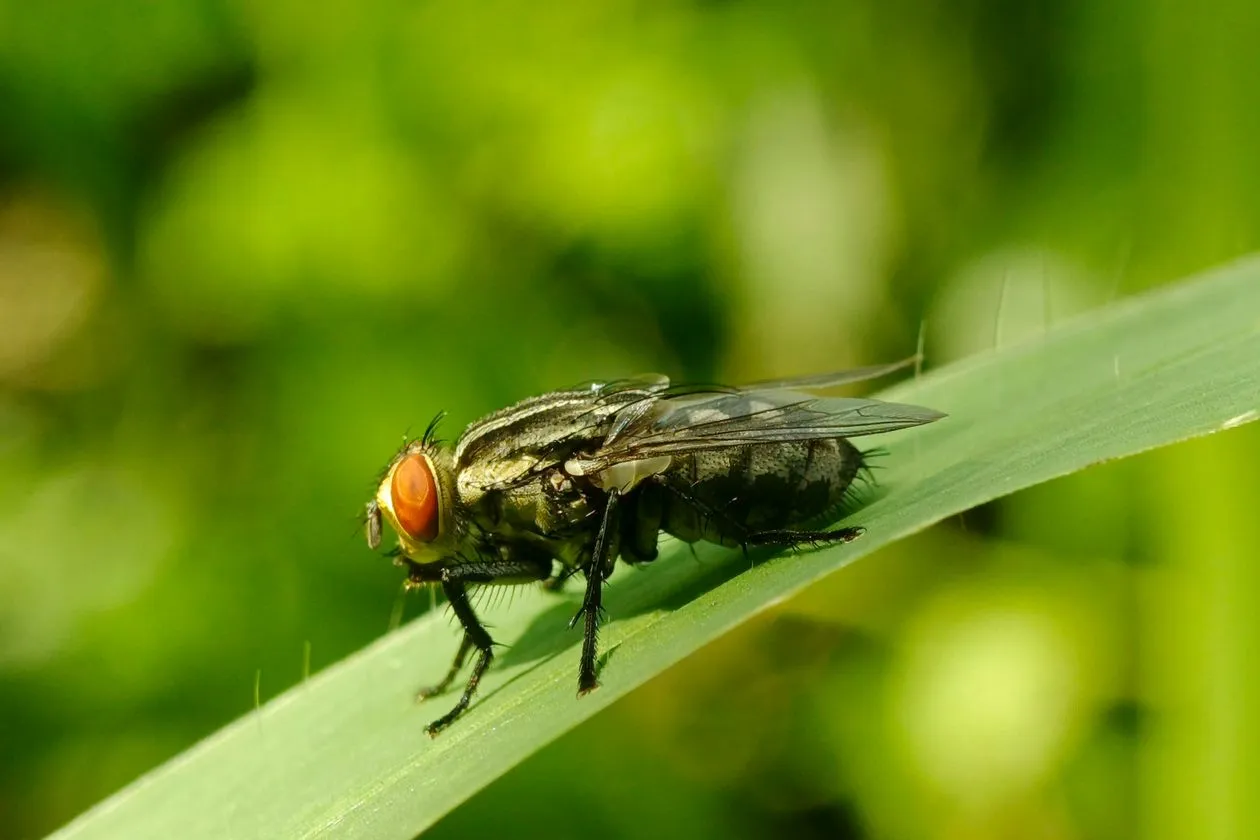
Flesh flies skip the shine. They are gray with three bold black stripes on the thorax, bright red eyes, and a checkerboard pattern on the belly. Unusually for flies, females deposit live larvae instead of eggs. One flesh fly basking on a sunny wall is normal; several indoors usually means a dead rodent somewhere in the structure.

Garden Helpers: Hoverflies, Robber Flies, Soldier Flies and Crane Flies
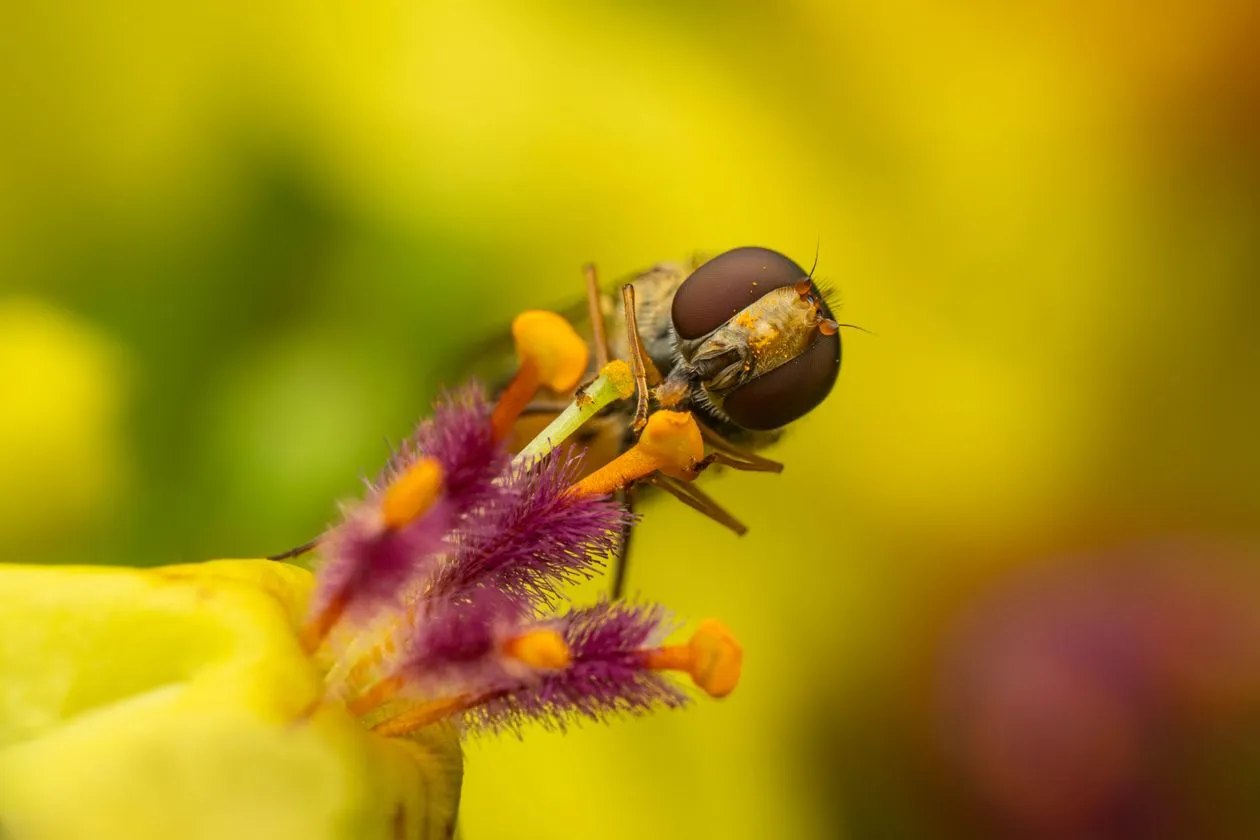
Not every striped insect in the garden is a threat. Hoverflies wear yellow and black bands to copy bees and wasps, but the disguise is bluff: they have one pair of wings, short antennae, and no sting at all. Adults pollinate flowers, and many species’ larvae patrol leaves eating aphids by the hundred. If you are separating the mimics from the real thing, our wasp identification chart and hornet identification chart show the genuine stingers side by side.
Robber flies are aerial hunters with a bristly beard and a humped thorax. They sit on a fence post, launch out, and grab bees, beetles, and pest flies in mid-air. Soldier flies look wasp-like but are harmless compost workers whose larvae break down kitchen scraps so efficiently that gardeners buy them on purpose. Crane flies look like giant mosquitoes with dangling legs, yet the adults cannot bite and many never feed at all. Their larvae live in damp lawns, where hunting dragonflies keep the adults in check.


Look-Alike Flies Compared
Four pairs cause most of the confusion. This quick table gives you the single check that separates each pair.
| Pair | Check this | First fly | Second fly |
|---|---|---|---|
| House fly vs Stable fly | Mouthparts and behavior | Soft sponging mouth, laps at food, never bites | Stiff bayonet mouthparts, lands on ankles and bites |
| Fruit fly vs Drain fly | Body and wings | Smooth tan body, red eyes, clear wings, hovers at fruit | Fuzzy moth-like body, hairy heart-shaped wings, sits at drains |
| Hoverfly vs Honey bee | Wing count | One pair of wings, huge eyes, cannot sting | Two pairs of wings, can sting |
| Crane fly vs Mosquito | Size and legs | Body up to 25 mm, legs dangle and snap off easily, no bite | Body under 8 mm, females bite |

What to Do Once You Know the Fly
Identification is the treatment plan. For the tiny indoor flies, skip the spray and remove the breeding source: clean the drain film, toss the fermenting fruit, fix the leak, let the plant soil dry. For house flies and blow flies, sanitation does the heavy lifting: sealed trash, pet waste picked up, screens on windows. A sudden crowd of blow or flesh flies indoors usually means something has died in a wall or attic, so find and remove it.
For biting flies, protect the person and the animals instead: repellent, fans on patios (weak fliers hate moving air), light clothing on trails near water. For cluster flies, seal the gaps around windows and siding in late summer before they move in. For the garden helpers, the right move is no move at all: hoverflies, robber flies, and soldier flies are free pest control and pollination in one package.
Frequently Asked Questions
What is the most common fly in US homes?
The house fly is the most common large fly indoors. Among the tiny ones, fruit flies and drain flies tie for first place, and the chart above separates them by eye color, wing shape, and where they gather.
Do flies bite people?
Most do not. The biters on this chart are stable flies (both sexes) and the females of horse flies, deer flies, black flies, and biting midges. House flies, fruit flies, and hoverflies cannot bite at all.
How can I tell a fly from a bee or wasp?
Count the wings. A fly has one pair; bees and wasps have two pairs. Flies also have much larger eyes and shorter antennae, and a hoverfly will hover in place in a way bees rarely do.
Why are there tiny flies around my kitchen sink?
If they are tan with red eyes and also gather at fruit, they are fruit flies breeding in something fermenting. If they are fuzzy and stay at the drain itself, they are drain flies breeding in the slime inside the pipe. The fix is different for each, which is why the identification matters.
Are hoverflies dangerous?
No. Hoverflies cannot sting or bite. The bee-like stripes are a costume that keeps predators away. Their larvae eat aphids and the adults pollinate, so gardeners count them as allies.
Conclusion
You do not need to learn thousands of species to name the fly in your kitchen or garden. Work the five steps, match the row in the fly identification chart, and you will land on the right name almost every time, along with the right fix. Most flies are harmless, a few are genuine pests, and some are quietly working for you. If your winged visitor turns out to have four scaly wings instead, our butterfly identification chart is the place to look next.

