

Sea turtles have swum the oceans for more than 100 million years, surviving long before the first land mammals walked the earth. Today there are only seven types of sea turtles left in the world, and learning to tell them apart is easier than you might think. Each species has its own size, shell pattern, habitat and story, which is exactly what this guide covers.
The chart below compares all seven sea turtle species side by side, with size, habitat, diet and conservation status for each one. Scroll further for a closer look at every species, a quick identification guide and answers to the questions people ask most often about sea turtles.
Types of Sea Turtles: Complete Species Chart
Use this reference chart to compare the seven living species at a glance. Lengths are shell (carapace) measurements of typical adults, and weights are averages rather than record maximums.
| Species | Scientific Name | Avg. Length | Avg. Weight | Main Habitat | Diet | IUCN Status |
|---|---|---|---|---|---|---|
| Green sea turtle | Chelonia mydas | 120 cm | 200 kg | Tropical and subtropical coasts | Seagrass and algae | Endangered |
| Loggerhead turtle | Caretta caretta | 90 cm | 135 kg | Coastal oceans worldwide | Crabs and mollusks | Vulnerable |
| Leatherback turtle | Dermochelys coriacea | 180 cm | 500 kg | Open ocean, all oceans | Jellyfish | Vulnerable |
| Hawksbill turtle | Eretmochelys imbricata | 90 cm | 80 kg | Tropical coral reefs | Sponges | Critically Endangered |
| Olive ridley turtle | Lepidochelys olivacea | 70 cm | 50 kg | Warm tropical waters | Crabs, shrimp, jellyfish | Vulnerable |
| Kemp’s ridley turtle | Lepidochelys kempii | 65 cm | 45 kg | Gulf of Mexico | Crabs | Critically Endangered |
| Flatback turtle | Natator depressus | 90 cm | 90 kg | Australian coastal waters | Soft corals, sea cucumbers | Data Deficient |

The 7 Sea Turtle Species, Explained
1. Green Sea Turtle
The green sea turtle is the one most people picture first. Adults have a smooth, heart-shaped shell in mottled brown and olive, and a small, rounded head. Despite the name, their shell is not green. The name comes from the greenish color of their body fat, which takes its color from the seagrass and algae they eat.
Green turtles are the only sea turtle species that eats mostly plants as an adult. Young turtles eat jellyfish and other soft prey, but adults graze on seagrass beds like underwater lawnmowers, which keeps the beds healthy. They live in tropical and subtropical waters around the world and can grow to about 120 cm long and 200 kg. In places like Hawaii, where they are called honu, they are a protected and culturally important species. To see the wider family these ocean swimmers belong to, browse our complete chart of all turtle species.

2. Loggerhead Turtle
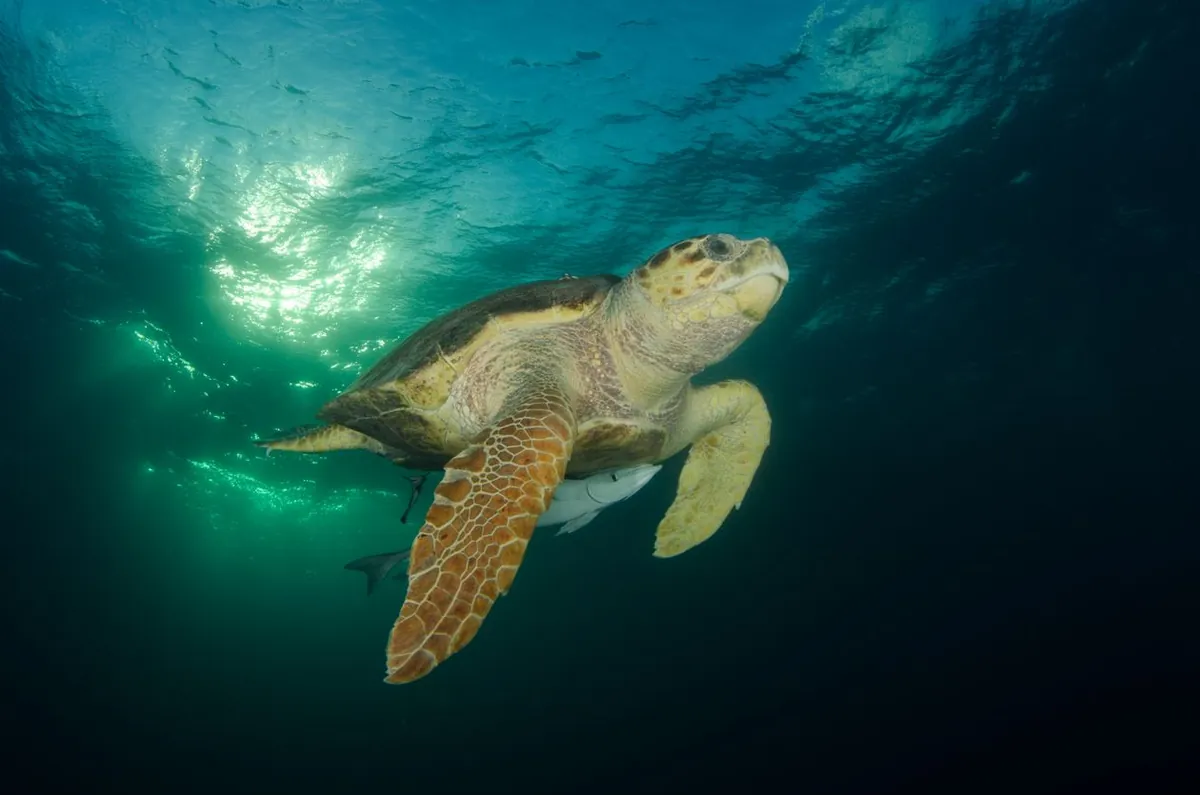
The loggerhead is easy to spot once you know what to look for: a very large, broad head and powerful jaws built for crushing hard-shelled prey like crabs, whelks and clams. Their shell is reddish brown with a slightly heart-shaped outline, and adults usually reach about 90 cm in length.
Loggerheads are excellent travelers. They nest on beaches from Florida to Japan, and young turtles drift on ocean currents for years before returning to coastal waters. Florida hosts the largest loggerhead nesting population in the world. Their strong jaws and stocky build make them one of the easiest types of sea turtles to identify in photos and in the water.
3. Leatherback Turtle
The leatherback is the giant of the group and the odd one out. Instead of a hard, scaly shell, it has a thick, leathery skin dotted with pale spots, with seven long ridges running front to back. It can reach 180 cm or more and weigh 500 kg, making it the largest turtle on earth, sea or land.
Leatherbacks are also champion divers. They plunge deeper than 1,000 meters chasing jellyfish, their favorite food, and they tolerate cold water better than any other sea turtle thanks to special blood flow in their bodies. This lets them swim from tropical nesting beaches all the way to cold northern seas. Leatherback hatchlings, with their scaly leathery shells and white-edged flippers, look unlike any other baby turtle.

4. Hawksbill Turtle
The hawksbill is the reef specialist. It has a narrow, pointed beak like a hawk, which it uses to reach sponges and sea anemones hiding in coral crevices. Its shell is famous for the overlapping, amber-colored scales with rich patterns, which sadly made it a target of the tortoiseshell trade for centuries.
Hawksbills are usually smaller than green turtles, reaching about 90 cm and 80 kg. They play a unique role on coral reefs by eating sponges that would otherwise smother the coral. Because of past shell trade and habitat loss, they are listed as Critically Endangered, and their colorful shells make them one of the most photographed types of sea turtles among divers.

5. Olive Ridley Turtle
The olive ridley is named for its olive-green, heart-shaped shell. At about 70 cm and 50 kg, it is one of the smaller species, but what it lacks in size it makes up for in numbers. Olive ridleys are famous for arribadas, mass nesting events where tens of thousands of females come ashore on the same beach over a few nights, mostly in Mexico, Costa Rica and India.
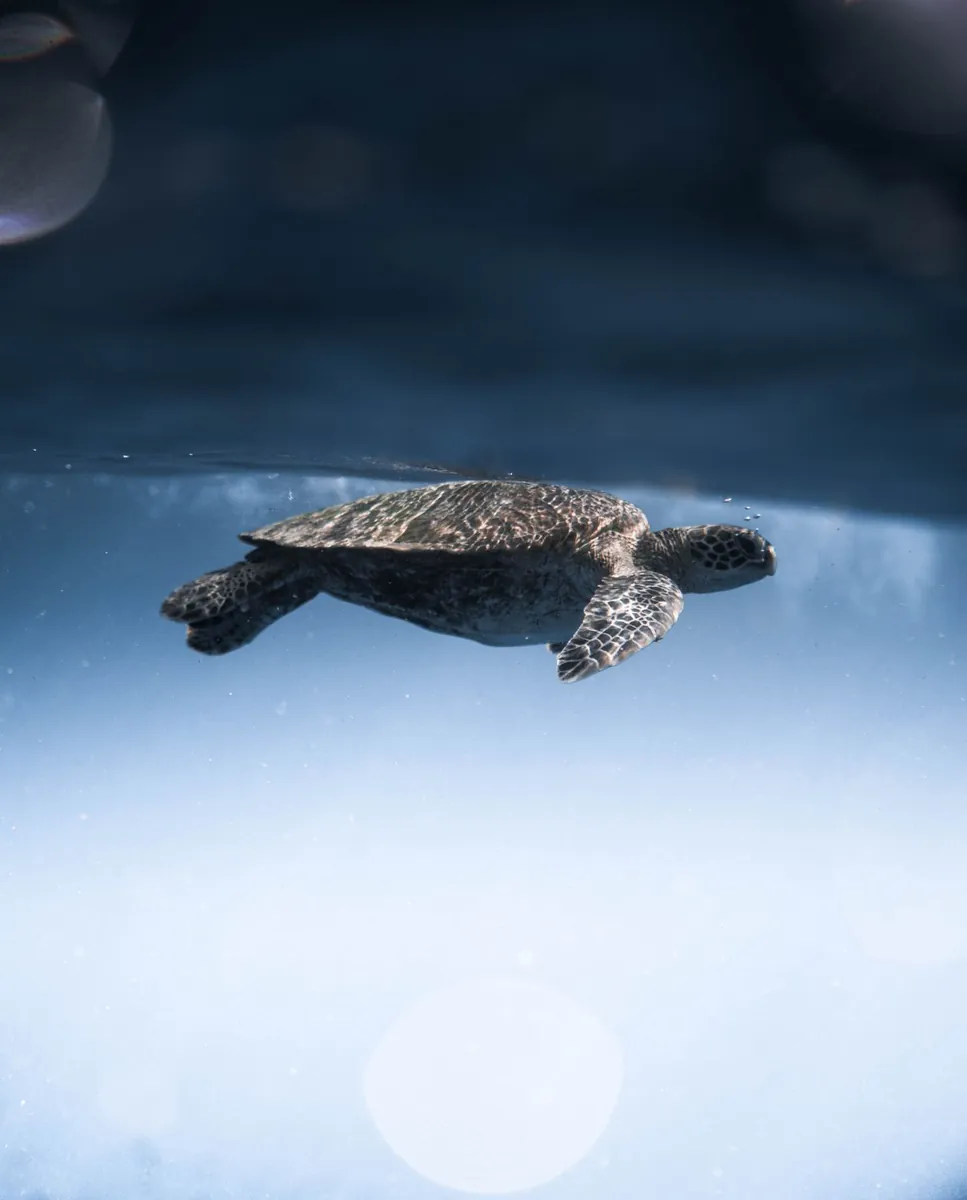
They are omnivores, feeding on crabs, shrimp, jellyfish and algae in warm tropical waters of the Pacific, Atlantic and Indian oceans. Their side view shows a compact, rounded shell and a head with distinctive pores between the eyes, a handy detail for identification.
6. Kemp’s Ridley Turtle
The Kemp’s ridley is the smallest and the rarest sea turtle in the world. Adults measure only about 65 cm and weigh around 45 kg. It is also the most range-limited species, nesting almost entirely on one stretch of beach in Tamaulipas, Mexico, with some nesting at Padre Island, Texas.
Kemp’s ridleys were pushed to the edge of extinction in the 1980s, when fewer than 300 nesting females were counted. Decades of beach protection and fishing-gear rules have helped numbers climb, but they remain Critically Endangered. They favor shallow Gulf of Mexico waters where they hunt crabs, and their nearly circular shell and pale underside set them apart from their close cousin, the olive ridley.

7. Flatback Turtle
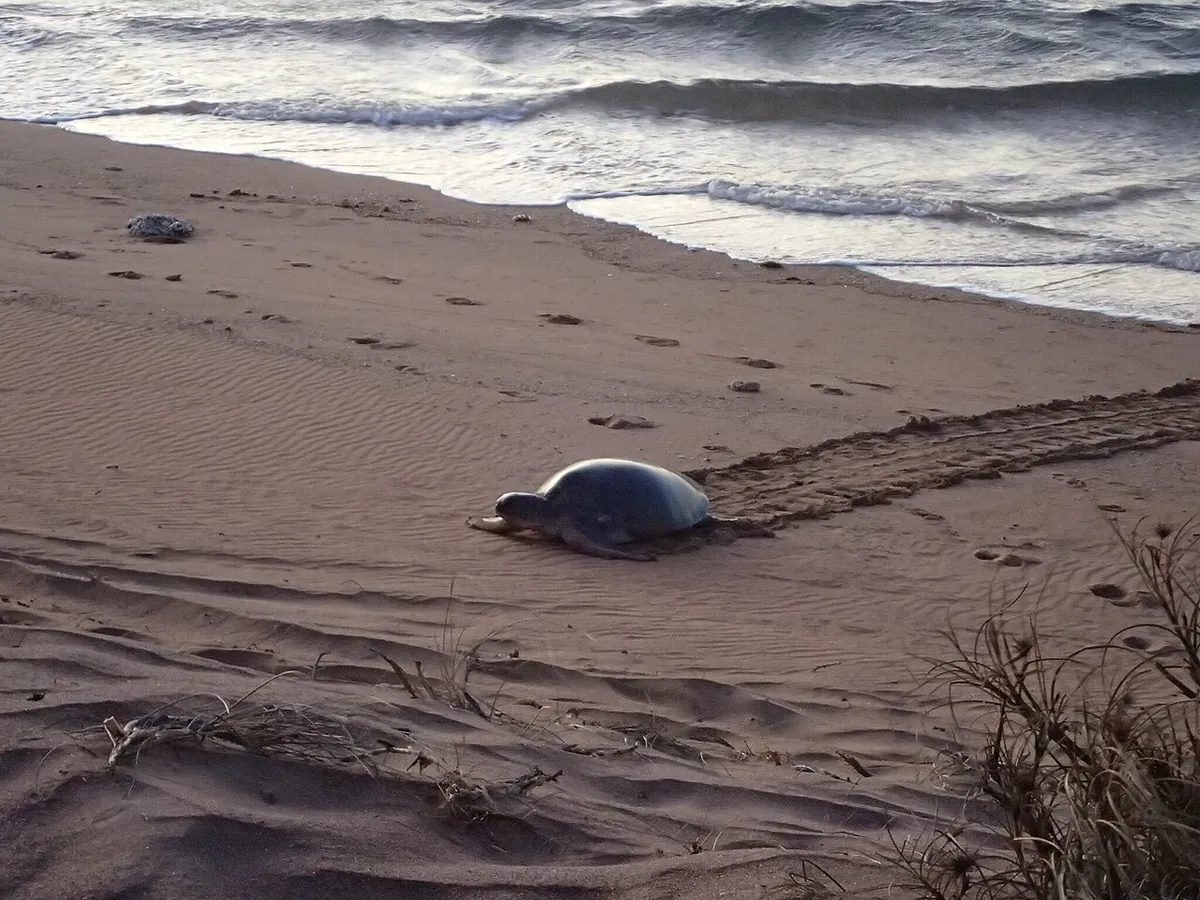
The flatback is the turtle almost nobody outside Australia has heard of. It lives only in Australian waters and nests only on Australian beaches, making it the only sea turtle species found on a single continent. Its shell has a noticeably flat profile with upturned edges, and adults reach about 90 cm and 90 kg.
Unlike the other six species, flatbacks stay close to shore their whole lives and never cross the open ocean. They feed on soft corals, sea cucumbers and jellyfish along the continental shelf. Scientists still know less about this species than any other sea turtle, which is why its IUCN status is listed as Data Deficient rather than a threat category.
How to Tell Sea Turtles Apart: Quick ID Guide
If you spot a sea turtle and want to name the species, run through these field marks in order:
- Shell texture: soft, leathery skin with pale spots means a leatherback. Hard shell means one of the other six.
- Head shape: a very large, blocky head with a strong jaw points to a loggerhead. A narrow, pointed beak points to a hawksbill.
- Shell color and pattern: amber, overlapping scales suggest a hawksbill. Olive-green, heart-shaped shell suggests an olive ridley. Dark, smooth shell with mottled brown suggests a green turtle.
- Size: a truly giant turtle, longer than a tall person, is almost certainly a leatherback. A very small adult, under 70 cm, is likely a Kemp’s or olive ridley.
- Location: a sea turtle seen only in Australian coastal waters is a flatback. One nesting in the Gulf of Mexico region is most likely a Kemp’s ridley.
For more animal identification practice, try our goose identification chart or the complete guide to types of penguins, which uses the same compare-by-species format.

Which Sea Turtles Are Endangered?
Two species are listed as Critically Endangered: the hawksbill and the Kemp’s ridley. The green turtle is listed as Endangered. The loggerhead, leatherback and olive ridley are listed as Vulnerable, and the flatback is listed as Data Deficient because not enough is known to judge its population.
The threats are mostly human caused: accidental capture in fishing nets, plastic pollution mistaken for jellyfish, beach development that destroys nesting sites, and artificial lights that confuse hatchlings. The good news is that protection works. Strict nest protection in Florida, for example, has helped green turtle nesting numbers climb, and international bans on the tortoiseshell trade have given hawksbills a chance to recover. Choosing seafood caught with turtle-safe methods and keeping nesting beaches dark at night are two simple ways anyone can help.

Frequently Asked Questions
How many types of sea turtles are there?
There are seven types of sea turtles in the world: green, loggerhead, leatherback, hawksbill, olive ridley, Kemp’s ridley and flatback. Six of them belong to the hard-shelled family Cheloniidae, and the leatherback belongs to its own family, Dermochelyidae.
What is the largest type of sea turtle?
The leatherback is the largest, reaching about 180 cm in shell length and 500 kg in weight, with exceptional individuals even bigger. It is the largest turtle of any kind, larger than any land tortoise or freshwater turtle.
What is the smallest type of sea turtle?
The Kemp’s ridley is the smallest, with adults averaging about 65 cm long and 45 kg. The olive ridley is only slightly larger, at around 70 cm and 50 kg.
Which type of sea turtle is the rarest?
The Kemp’s ridley is the rarest, nesting on a very small number of beaches in Mexico and Texas. The hawksbill is also extremely threatened and is classified as Critically Endangered.
Conclusion
Seven species, seven different ways of life: the plant-eating green turtle, the crab-crushing loggerhead, the giant leatherback, the reef-dwelling hawksbill, the mass-nesting olive ridley, the tiny Kemp’s ridley and the Australia-only flatback. Once you know the field marks, from the leatherback’s spotted leathery skin to the hawksbill’s pointed beak, identifying the types of sea turtles becomes a skill you can use on any tropical coast.
Bookmark the chart above for your next beach trip or dive, and keep exploring our animal reference charts. Every species you learn to recognize is a small step toward understanding and protecting the oceans these ancient travelers call home.


Pingback: Types of Dolphins: 20 Species, Sizes, Habitats and Facts – Chart Identify
Pingback: Types of Sharks: 20 Species, Sizes, Habitats and Facts – Chart Identify
Pingback: Types of Frogs: 20 Species with Pictures, Sizes and Habitats – Chart Identify
Pingback: Types of Octopus: 15 Species, Sizes, Habitats and Facts – Chart Identify
Pingback: Sea Turtle Lifespan Chart: How Long Sea Turtles Live – Chart Identify